Originally posted by Tribune Media Services
COPYRIGHT © 2011 GREG SCHWEM DISTRIBUTED BY TRIBUNE MEDIA SERVICES, INC
As a Chicago resident and die-hard Cubs fan, I'm used to living through springs that begin with so much promise, only to turn into summers full of zero improvement and wasted opportunities, followed by September cries of "wait till next year."
My golf game plays out in identical fashion.
But I have a new reason to be hopeful. Peer inside my bag and feast your eyes on that gleaming putter. DON'T TOUCH IT! You see, that putter was designed EXCLUSIVELY for me.
Now I've never been a huge believer in the theory that technology improves one's golf game. I've shunned pricey balls that supposedly fly higher, truer and farther thanks to their "unconventional dimple design" and "dual core" centers. They all sink equally well in water. Give me a ball that bobs to the surface, floats quickly to the bank and waits for my cart to arrive and I'll purchase six dozen.
Ditto for drivers with adjustable screws that allow the owner to fade or draw the ball. I've been playing golf for more than 40 years and nobody has ever stood on the tee and said, "Whatever you do, don't hit it STRAIGHT."
Putting, however, is a different story. Like most weekend players, I spend precious little time practicing putting. It's more fun to pound driver after driver, wallowing in my own testosterone as I try to reach the 275-yard flag on the range. Putting just seems so . . . wimpy by nature.
Nevertheless, the soft spongy putting surface is where my game goes to die. That's why I was so intrigued with the concept of a custom-designed putter. I interpreted that to mean I would now own a putter that would be more than a club; it would be my best friend. I would take it into bars after rounds and sit it on an adjoining stool, while recounting to other golfers how I made three 40-footers simply because "my putter knows what to do." In short, it would be the sword of Excalibur.
I happily met Mike, my custom putter fitter, in an unremarkable office park where remarkable putters are allegedly born. While I attempted to sink several 8-foot putts, Mike videotaped my stroke. I watched in horror and immediately updated a mental list entitled, "Things I NEVER Want to See on a Big Screen." My golf swing became No. 1. "Me Having Sex" dropped to No. 2.
Mike went into another room, most likely to convulse in laughter. He returned with several putters and twice as much putting terminology. I nodded silently as he described my "toe drag," and "forward press."
The only term I understood was "wristy," as in, "You're way too wristy."
Over the next hour, Mike tried everything to reduce my wrist, short of breaking it. I putted with my head against a wall, with a ball wedged between the shaft and my right forearm, with my left hand only, my right hand only and with my eyes closed. Remarkably that one went in; at least it sounded like it did.
He then took the putter from my hands, placed it in some contraption that may very well have come from a CIA interrogation room, made some noisy adjustments and returned it to me.
"You're good to go," he said.
I handed him a large amount of money and he handed me the putter and his card. "If you make any changes to your stroke, bring it back." I interpreted that to mean he would make more adjustments, courtesy of the mystery machine.
I headed out convinced that the machine and the putter will cure me of my putting woes because I now have technology on my side. It's like having a GPS in your vehicle. Voila! Suddenly you are good at directions.
I don't plan to miss any more putts inside 10 feet. But in case I do, I have one question.
What do custom-designed wrists cost?

One Against Three...and The Dog Makes Four is the blog of corporate stand-up comedian,author and nationally syndicated Tribune Media columnist Greg Schwem. Read how Greg survives in a family that includes his wife, two daughters and yes, a female dog. Hungry for more? Check out Greg's book, "Text Me If You're Breathing: Observations, Frustrations and Life Lessons From a Low Tech Dad" now available at your favorite on line or retail bookstore
Monday, October 17, 2011


Tuesday, October 11, 2011
It Takes Very Little Effort to be a Man
Originally posted by Tribune Media Services
COPYRIGHT © 2011 GREG SCHWEM DISTRIBUTED BY TRIBUNE MEDIA SERVICES, INC
I avoid reading medical studies since they are contradictory by nature. Stay away from red wine because the alcohol could raise my blood pressure or inhale two glasses a day and combat prostate cancer? Control my cholesterol by shunning beef or strengthen my immune system by waltzing into Ruth's Chris once a week and nodding when the waitress says, "The usual, Mr. Schwem?"
But something lead me to read, beginning to end, a recent study by Northwestern University anthropologists. Apparently, testosterone, the primary male sex hormone, drops when men become dads. Even more alarming? The study suggests levels plummet further when guys take active roles in child rearing. In short: The more involved a man is with his kids, the less "manly energy" he has.
I recently turned 49 and, while I don't feel the need to star in a Cialis commercial, I occasionally struggle to remain awake through the late-night news. Now I know why. It was because I spent this past spring managing my 9-year-old daughter's softball team. I specifically remember one game when I stood near third base, frantically waving my arm in a circular motion and extolling our runner to sprint home. How was I to know that testosterone was oozing out of my body? Those dads in the bleachers who spent the whole game tapping away on their BlackBerrys no doubt left feeling more like men.
Then there was that snowy Sunday a few years ago when I went bowling with her Brownie troop. While other dads were home on the couch eating Doritos and watching the playoffs, I was tying little bowling shoes and searching the lanes for pink balls. When the facility closed for the evening, the staff likely squeegeed my testosterone off alley No. 7.
Or maybe I lost that all important maleness when I transported a bunch of girls to a weekend cheerleading tournament 75 miles from my house. Actually, that's not true; any man forced to sit through a cheerleading tournament ceases being a man on the spot. That includes you, Tom Brady. I knew it was over when my wife sent me to the drugstore because my daughter didn't have the correct shade of eyeliner that apparently is VITAL when competing in cheerleading competitions.
Luckily, there is a solution to every problem. Starting today, I plan to replenish that lost testosterone -- by becoming as uninvolved as possible.
From now on, when my daughter requests help with her science report, I will quickly wave my hand in the direction of the home PC and say, "Just Google it." When it comes time to sort her Girl Scout cookie order, I will give her a look that says, "You sold 'em, you bag 'em." So what if the kindly old lady down the street gets three boxes of Peanut Butter Patties instead of the Thin Mints she requested? As long as she doesn't have a serious peanut allergy, who cares?
Citing my plunging testosterone levels, I will contact my daughter's principal and renege on my promise to volunteer in the school's computer lab. (That should be an interesting phone call.) As an alternative, I will offer to teach fourth-graders the intricacies of Skype by conducting a video chat from my couch while doing something manly like updating my Fantasy Football stats. My hormone levels will soar.
I will cede all car pool duties to my wife. Oh sure, she will blow a gasket upon realizing that she has to be in four places at once, but I will firmly remind her that my lack of mobility is doing wonders for my virility. End of conversation.
Just when she threatens divorce, I will whisk her off to a secluded Caribbean island and spend three days proving what laziness can do for a man, if you catch my drift. When we return, our children will warmly greet us at the door and beg for attention.
I hope I can remember their names.
COPYRIGHT © 2011 GREG SCHWEM DISTRIBUTED BY TRIBUNE MEDIA SERVICES, INC
I avoid reading medical studies since they are contradictory by nature. Stay away from red wine because the alcohol could raise my blood pressure or inhale two glasses a day and combat prostate cancer? Control my cholesterol by shunning beef or strengthen my immune system by waltzing into Ruth's Chris once a week and nodding when the waitress says, "The usual, Mr. Schwem?"
But something lead me to read, beginning to end, a recent study by Northwestern University anthropologists. Apparently, testosterone, the primary male sex hormone, drops when men become dads. Even more alarming? The study suggests levels plummet further when guys take active roles in child rearing. In short: The more involved a man is with his kids, the less "manly energy" he has.
I recently turned 49 and, while I don't feel the need to star in a Cialis commercial, I occasionally struggle to remain awake through the late-night news. Now I know why. It was because I spent this past spring managing my 9-year-old daughter's softball team. I specifically remember one game when I stood near third base, frantically waving my arm in a circular motion and extolling our runner to sprint home. How was I to know that testosterone was oozing out of my body? Those dads in the bleachers who spent the whole game tapping away on their BlackBerrys no doubt left feeling more like men.
Then there was that snowy Sunday a few years ago when I went bowling with her Brownie troop. While other dads were home on the couch eating Doritos and watching the playoffs, I was tying little bowling shoes and searching the lanes for pink balls. When the facility closed for the evening, the staff likely squeegeed my testosterone off alley No. 7.
Or maybe I lost that all important maleness when I transported a bunch of girls to a weekend cheerleading tournament 75 miles from my house. Actually, that's not true; any man forced to sit through a cheerleading tournament ceases being a man on the spot. That includes you, Tom Brady. I knew it was over when my wife sent me to the drugstore because my daughter didn't have the correct shade of eyeliner that apparently is VITAL when competing in cheerleading competitions.
Luckily, there is a solution to every problem. Starting today, I plan to replenish that lost testosterone -- by becoming as uninvolved as possible.
From now on, when my daughter requests help with her science report, I will quickly wave my hand in the direction of the home PC and say, "Just Google it." When it comes time to sort her Girl Scout cookie order, I will give her a look that says, "You sold 'em, you bag 'em." So what if the kindly old lady down the street gets three boxes of Peanut Butter Patties instead of the Thin Mints she requested? As long as she doesn't have a serious peanut allergy, who cares?
Citing my plunging testosterone levels, I will contact my daughter's principal and renege on my promise to volunteer in the school's computer lab. (That should be an interesting phone call.) As an alternative, I will offer to teach fourth-graders the intricacies of Skype by conducting a video chat from my couch while doing something manly like updating my Fantasy Football stats. My hormone levels will soar.
I will cede all car pool duties to my wife. Oh sure, she will blow a gasket upon realizing that she has to be in four places at once, but I will firmly remind her that my lack of mobility is doing wonders for my virility. End of conversation.
Just when she threatens divorce, I will whisk her off to a secluded Caribbean island and spend three days proving what laziness can do for a man, if you catch my drift. When we return, our children will warmly greet us at the door and beg for attention.
I hope I can remember their names.
Monday, October 03, 2011
Congress Needs a Three-Martini Lunch
Originally posted by Tribune Media Services
COPYRIGHT © 2011 GREG SCHWEM DISTRIBUTED BY TRIBUNE MEDIA SERVICES, INC
As Congress continues to bumble its way through existence, I feel it's finally time to step in and offer a solution that will solve our nation's ills.
The Three Martini Lunch.
Whatever happened to that sacred ritual of negotiation, so popular in the 1960s and '70s? The guys on Mad Men close multimillion-dollar deals every week over martinis. My dad, a retired salesman, paid for my college tuition with the help of a few vodka soaked olives and a veal shank with soup, salad and baked potato. Liquid libation, he argued, could loosen up the tightest customer. And right now, Congress is tighter than the faces on The Real Housewives of Beverly Hills.
Blame stricter drunk-driving laws for the drinking lunch's demise. Blame company wellness programs. Blame image-conscious individuals, wary of ordering alcohol before 5 p.m. Those three reasons are precisely why Washington has nothing to lose by airing its beefs with a little Beefeater. One, our nation's Capitol teems with chauffeurs and private car services. Two, House Speaker John Boehner, R-Camel Light, isn't exactly on a health kick. Furthermore, former Rep. Anthony Weiner proved that the congressional gym is not necessarily used for fitness. Three, Congress' image ranks just below navel lint.
So, before our nation runs out of money, defaults on its national debt and slides deeper into recession, somebody please make a noon reservation at a Washington power eatery where Boehner, House Majority Leader Eric Cantor, Senate Majority Leader Harry Reid and Treasury Secretary Tim Geithner can loosen their ties and their viewpoints. A waitress is at the ready.
"Hello, Gentlemen. Can I start you off with some drinks? Mr. Reid?"
"I'll get the first round. Four vodka martinis. Straight up."
"Make mine an appletini."
"Cantor, this is a negotiation, not a frat party."
"OK, straight up. With a cherry."
"Whatever. Tim, where are we at?
"It's pretty obvious. We're down to a couple billion and some change in the coffers. The clock is ticking."
"That's because Harry here won't budge on disaster relief spending."
"Excuse me, John, for wanting to help the residents of Joplin."
"Harry, you're getting on my nerves."
"Pardon me, gentlemen. Another round?"
"Don't mind if we do. And an order of calamari."
"Right away, Mr. Geithner. But we can't take a check from the Treasury. Remember what happened last time?"
"I'll pay cash."
"Guys, we have to cut more social service programs. Isn't that obvious?"
"Not as obvious as the Redskins' play-calling. Eric, did you see that game yesterday?"
"Here's some food for thought. If we cut $2 billion from the budget, we could buy the team. How cool would that be?"
"Your drinks, gentlemen. And the special today is prime rib. Are you ready to order?"
"Can you give us a few minutes? We're trying to keep the government running."
"C'mon Tim! I'm starving.
"Agree on spending cuts and I'll get her back here."
"Fine. Cut the alternative energy loan program."
"And tell the victims of Irene they don't have to worry. FEMA will be there."
"Great. That went pretty smoothly, didn't it?"
"Not as smooth as this Grey Goose. Yowza!"
"So, John, how's your golf game?"
"Thanks for asking Harry. It's decent. We should get out some time. I'll call the president. He's always up for 18."
"Need a fourth?"
"We've got your cell, Eric."
"Boys, we probably have time for one more before the food arrives. Can we agree that we're not going to put the American people through another debt ceiling debacle?"
"Yeah, we did look pretty stupid on that one. (HICCUP) I'd be willing to forego my pension for a few years."
"I'll go you one better. (BURP) I'll give up my Social Security. Tim, figure out my monthly benefits for the next 10 years and just give the money to a laid off worker with a family. "
"I love you guys. Waitress, four more."
"Coming right up, gentlemen. Will you be needing cabs after lunch?"
"Don't worry. We've got a designated driver."
"Yeah, Mrs. Pelosi is waiting outside."
COPYRIGHT © 2011 GREG SCHWEM DISTRIBUTED BY TRIBUNE MEDIA SERVICES, INC
As Congress continues to bumble its way through existence, I feel it's finally time to step in and offer a solution that will solve our nation's ills.
The Three Martini Lunch.
Whatever happened to that sacred ritual of negotiation, so popular in the 1960s and '70s? The guys on Mad Men close multimillion-dollar deals every week over martinis. My dad, a retired salesman, paid for my college tuition with the help of a few vodka soaked olives and a veal shank with soup, salad and baked potato. Liquid libation, he argued, could loosen up the tightest customer. And right now, Congress is tighter than the faces on The Real Housewives of Beverly Hills.
Blame stricter drunk-driving laws for the drinking lunch's demise. Blame company wellness programs. Blame image-conscious individuals, wary of ordering alcohol before 5 p.m. Those three reasons are precisely why Washington has nothing to lose by airing its beefs with a little Beefeater. One, our nation's Capitol teems with chauffeurs and private car services. Two, House Speaker John Boehner, R-Camel Light, isn't exactly on a health kick. Furthermore, former Rep. Anthony Weiner proved that the congressional gym is not necessarily used for fitness. Three, Congress' image ranks just below navel lint.
So, before our nation runs out of money, defaults on its national debt and slides deeper into recession, somebody please make a noon reservation at a Washington power eatery where Boehner, House Majority Leader Eric Cantor, Senate Majority Leader Harry Reid and Treasury Secretary Tim Geithner can loosen their ties and their viewpoints. A waitress is at the ready.
"Hello, Gentlemen. Can I start you off with some drinks? Mr. Reid?"
"I'll get the first round. Four vodka martinis. Straight up."
"Make mine an appletini."
"Cantor, this is a negotiation, not a frat party."
"OK, straight up. With a cherry."
"Whatever. Tim, where are we at?
"It's pretty obvious. We're down to a couple billion and some change in the coffers. The clock is ticking."
"That's because Harry here won't budge on disaster relief spending."
"Excuse me, John, for wanting to help the residents of Joplin."
"Harry, you're getting on my nerves."
"Pardon me, gentlemen. Another round?"
"Don't mind if we do. And an order of calamari."
"Right away, Mr. Geithner. But we can't take a check from the Treasury. Remember what happened last time?"
"I'll pay cash."
"Guys, we have to cut more social service programs. Isn't that obvious?"
"Not as obvious as the Redskins' play-calling. Eric, did you see that game yesterday?"
"Here's some food for thought. If we cut $2 billion from the budget, we could buy the team. How cool would that be?"
"Your drinks, gentlemen. And the special today is prime rib. Are you ready to order?"
"Can you give us a few minutes? We're trying to keep the government running."
"C'mon Tim! I'm starving.
"Agree on spending cuts and I'll get her back here."
"Fine. Cut the alternative energy loan program."
"And tell the victims of Irene they don't have to worry. FEMA will be there."
"Great. That went pretty smoothly, didn't it?"
"Not as smooth as this Grey Goose. Yowza!"
"So, John, how's your golf game?"
"Thanks for asking Harry. It's decent. We should get out some time. I'll call the president. He's always up for 18."
"Need a fourth?"
"We've got your cell, Eric."
"Boys, we probably have time for one more before the food arrives. Can we agree that we're not going to put the American people through another debt ceiling debacle?"
"Yeah, we did look pretty stupid on that one. (HICCUP) I'd be willing to forego my pension for a few years."
"I'll go you one better. (BURP) I'll give up my Social Security. Tim, figure out my monthly benefits for the next 10 years and just give the money to a laid off worker with a family. "
"I love you guys. Waitress, four more."
"Coming right up, gentlemen. Will you be needing cabs after lunch?"
"Don't worry. We've got a designated driver."
"Yeah, Mrs. Pelosi is waiting outside."
Monday, September 26, 2011
Mark Zuckerberg Needs Some Kids!
Originally posted by Tribune Media Services
COPYRIGHT © 2011 GREG SCHWEM DISTRIBUTED BY TRIBUNE MEDIA SERVICES, INC
The last time I Googled Mark Zuckerberg, he was a 27-year-old billionaire who invented Facebook.
Prior to that he was a 26-year-old billionaire who invented Facebook.
The only thing changing in Zuckerberg's life these days is the amount of money he accumulates with his creation. Oh, sure, he pops up in the occasional news story such as the one involving a Northern Ireland dad who is suing Facebook because his 12-year-old daughter posted sexually explicit photos of herself on the site. Facebook, the dad contends, doesn't enforce its policy of forbidding users to establish accounts until they reach the ripe old age of . . . 13. That policy was actually the result of the Children's Online Privacy Protection Act. Zuckerberg has hinted that he might try to challenge the rule. Younger children, he argued, should be allowed to use Facebook for "educational purposes."
It's easy to see why Zuckerberg made that statement: He doesn't have children of his own. At least, I don't think he does. Hard to believe, but he hasn't updated his Facebook page since January. I'm pretty certain that siring an offspring would at least merit a post. And a photo.
I think I speak for all parents when I say Zuckerberg needs to experience firsthand why we agonize over when to let our own children explore Facebook. Which is exactly why I'm going to launch a campaign: MARK ZUCKERBERG NEEDS SOME KIDS. And I'm going to use Facebook.
I will create a simple Facebook page and ask my 357 friends to "like" it. Then I will invite them all to an event, created via Facebook, entitled, "Drop Your Kids Off at Mark Zuckerberg's House For a Week." Most billionaires have at least a couple spare bedrooms, don't they?
I will get the ball rolling by letting my daughters stay with Zuckerberg. One is 14 and a legal Facebook member. Before letting her join, her mother and I warned her that we would be closely monitoring her activity. We friended her, memorized her password, turned off her instant personalization feature and disabled apps such as AreYouInterested? -- which, according to Facebook, "makes it virtually effortless to meet potential dates instantly." So far, she has behaved responsibly. Still, we can't always control the posts from her 600-plus friends, some of whom freely drop f-bombs, question their classmates' sexual orientation online and wonder if anyone will be bringing alcohol to the party. Maybe Zuckerberg has some suggestions.
He will have a bigger problem dealing with my 9 year old. She's too young for Facebook, but somehow, a few of her 9-year-old friends have established accounts. One even tried to friend me. Isn't that cute? A 9-year-old girl wants to be friends with a 49-year-old man! It's only a matter of time before my daughter begins pestering me for an account. I'll let Zuckerberg deal with that when he tucks her in at night and brushes her pigtails the next morning.
Once a few kids get dropped off at Mr. Z's home, others will certainly follow. I know this because the Facebook Places app helps users broadcast exactly where they are. Word travels fast via social networks; just ask shopkeepers in England.
My wife and I weren't worried about British looters when we agreed to host a graduation party for our daughter. However, we did tell her that, under no circumstances, could she promote the event via Facebook. As a result, we had a nice quiet gathering of about 40 kids, all of whom we recognized. Other parents weren't so lucky; one party we attended contained over 100 eighth-grade grads, thanks primarily to Facebook. At one point, the homeowner gazed out at his backyard, sighed and said, "Who ARE these kids?"
Eventually my Facebook friends and I will descend on Zuckerberg's home, collect our children and restore sanity to his life. Maybe he will use the subsequent quiet time to rethink Facebook's age policy. If he needs additional input, there's a dad in Northern Ireland who may have some ideas.
Zuckerberg should send him a friend request first.
(Greg Schwem is a stand-up comedian and author of "Text Me If You're Breathing: Observations, Frustrations and Life Lessons From a Low-Tech Dad," available at http://amzn.to/schwem.)
COPYRIGHT © 2011 GREG SCHWEM DISTRIBUTED BY TRIBUNE MEDIA SERVICES, INC
The last time I Googled Mark Zuckerberg, he was a 27-year-old billionaire who invented Facebook.
Prior to that he was a 26-year-old billionaire who invented Facebook.
The only thing changing in Zuckerberg's life these days is the amount of money he accumulates with his creation. Oh, sure, he pops up in the occasional news story such as the one involving a Northern Ireland dad who is suing Facebook because his 12-year-old daughter posted sexually explicit photos of herself on the site. Facebook, the dad contends, doesn't enforce its policy of forbidding users to establish accounts until they reach the ripe old age of . . . 13. That policy was actually the result of the Children's Online Privacy Protection Act. Zuckerberg has hinted that he might try to challenge the rule. Younger children, he argued, should be allowed to use Facebook for "educational purposes."
It's easy to see why Zuckerberg made that statement: He doesn't have children of his own. At least, I don't think he does. Hard to believe, but he hasn't updated his Facebook page since January. I'm pretty certain that siring an offspring would at least merit a post. And a photo.
I think I speak for all parents when I say Zuckerberg needs to experience firsthand why we agonize over when to let our own children explore Facebook. Which is exactly why I'm going to launch a campaign: MARK ZUCKERBERG NEEDS SOME KIDS. And I'm going to use Facebook.
I will create a simple Facebook page and ask my 357 friends to "like" it. Then I will invite them all to an event, created via Facebook, entitled, "Drop Your Kids Off at Mark Zuckerberg's House For a Week." Most billionaires have at least a couple spare bedrooms, don't they?
I will get the ball rolling by letting my daughters stay with Zuckerberg. One is 14 and a legal Facebook member. Before letting her join, her mother and I warned her that we would be closely monitoring her activity. We friended her, memorized her password, turned off her instant personalization feature and disabled apps such as AreYouInterested? -- which, according to Facebook, "makes it virtually effortless to meet potential dates instantly." So far, she has behaved responsibly. Still, we can't always control the posts from her 600-plus friends, some of whom freely drop f-bombs, question their classmates' sexual orientation online and wonder if anyone will be bringing alcohol to the party. Maybe Zuckerberg has some suggestions.
He will have a bigger problem dealing with my 9 year old. She's too young for Facebook, but somehow, a few of her 9-year-old friends have established accounts. One even tried to friend me. Isn't that cute? A 9-year-old girl wants to be friends with a 49-year-old man! It's only a matter of time before my daughter begins pestering me for an account. I'll let Zuckerberg deal with that when he tucks her in at night and brushes her pigtails the next morning.
Once a few kids get dropped off at Mr. Z's home, others will certainly follow. I know this because the Facebook Places app helps users broadcast exactly where they are. Word travels fast via social networks; just ask shopkeepers in England.
My wife and I weren't worried about British looters when we agreed to host a graduation party for our daughter. However, we did tell her that, under no circumstances, could she promote the event via Facebook. As a result, we had a nice quiet gathering of about 40 kids, all of whom we recognized. Other parents weren't so lucky; one party we attended contained over 100 eighth-grade grads, thanks primarily to Facebook. At one point, the homeowner gazed out at his backyard, sighed and said, "Who ARE these kids?"
Eventually my Facebook friends and I will descend on Zuckerberg's home, collect our children and restore sanity to his life. Maybe he will use the subsequent quiet time to rethink Facebook's age policy. If he needs additional input, there's a dad in Northern Ireland who may have some ideas.
Zuckerberg should send him a friend request first.
(Greg Schwem is a stand-up comedian and author of "Text Me If You're Breathing: Observations, Frustrations and Life Lessons From a Low-Tech Dad," available at http://amzn.to/schwem.)
Wednesday, September 14, 2011
Thankfully, Nevin Shapiro Never had Children
Originally posted by Tribune Media Services
COPYRIGHT © 2011 GREG SCHWEM DISTRIBUTED BY TRIBUNE MEDIA SERVICES, INC
There is football on my TV, the greens of my backyard leaves are slowly giving way to fiery reds and my kids have resumed both school and youth sports programs.
As long as Nevin Shapiro stays in jail, it's going to be a great fall.
Shapiro is the Miami "businessman" currently serving a 20-year prison sentence for orchestrating a $930 million Ponzi scheme. But it was his dealings with University of Miami football players that really put him on the map. Shapiro admitted to a Yahoo sports reporter that he lavished cash and gifts on Miami players and recruits, threw outrageous parties featuring strippers and hookers, paid players for vicious hits and did it all over an eight-year period while nobody thought to question him, including Miami coaches who allegedly also benefitted from Shapiro's largesse.
Unless O.J. Simpson gets transferred to the same correctional facility, Shapiro is now far away from sports figures. This is a good thing because, had Shapiro's misdeeds continued to go unnoticed, he may have tired of his hard-partying bachelor ways, gotten married, had children and settled into a life of suburbia. Like me, maybe he would have a daughter. Like me, maybe his daughter would play soccer. What if our kids ended up on the same team? Any adult who has ever experienced youth soccer knows that some parents can be overly vocal at best and downright nuts at worst. The last thing my daughter's team needs is a guy rolling up to the field in a tricked out minivan.
"Hey, Ned, who's the guy wearing the extra large Strawberry Shortcake team jersey?"
"Greg, that's Nevin Shapiro. His daughter's the starting midfielder. Of course, what did you expect? He threw that all-night party at Chuck E. Cheese last weekend."
"Is that the guy the other kids call, 'The dad with the tokens?'"
"That's him. And he's got more than tokens. Have you seen his house?"
"Is it the one with the 100-foot inflatable jumper in the backyard? My daughter was there for eight hours yesterday. OOOOH, did you see that? One of our kids just kneed another player in the stomach. Poor kid. She's crying. They're going to have to take her out of the game. Looks like our player is going to get a red card."
"And a Dairy Queen coupon."
"A what?"
"Haven't you heard? Shapiro gives free ice cream to any kid who incapacitates an opposing player. Sure, our player's done for the day, but in an hour she's going to be eating a Peanut Buster Parfait."
"No wonder my daughter wants to take kick boxing lessons. By the way, Ned, are we home or away next weekend?"
"We're home. Eleven a.m. at Shapiro Field."
"Excuse me?"
"Didn't you get the email? They named our field after this guy. In return he's buying new warm-up jackets for all the girls. The coaches made the decision last night at Buffalo Wild Wings."
"Let me guess. Shapiro paid."
"You got it."
"Hey, Ned, do you recognize the three 7-year-olds on the sideline? Are they from around here?"
"No, Greg. They're from Mexico. Potential recruits."
"Recruits? From Mexico?"
"Shapiro flew them up here. Thinks they'll be great additions to the team."
"Don't you have to live in our town to play youth soccer for this team?"
"Hey, I don't ask questions. Apparently these kids have some serious moves."
So, let me get this straight: We're using illegal recruits, encouraging our kids to hurt opposing players, bribing them with pizza parties and fancy clothes and nobody thinks this is wrong?"
"Greg, we're 7-0. Zip it."
"How much time is left in this game, anyway?"
"That was the whistle. Looks like we're 8-0 now."
"Here comes my daughter. Nice game honey!"
"Thanks, Dad."
"Hey, since your grandparents drove all the way here to watch you, how about we all go to McDonald's and celebrate?"
"Maybe another time. Mr. Shapiro is taking the whole team to the Apple Store."
"Oh. Uh, do you need any money?"
"Very funny, Daddy."
COPYRIGHT © 2011 GREG SCHWEM DISTRIBUTED BY TRIBUNE MEDIA SERVICES, INC
There is football on my TV, the greens of my backyard leaves are slowly giving way to fiery reds and my kids have resumed both school and youth sports programs.
As long as Nevin Shapiro stays in jail, it's going to be a great fall.
Shapiro is the Miami "businessman" currently serving a 20-year prison sentence for orchestrating a $930 million Ponzi scheme. But it was his dealings with University of Miami football players that really put him on the map. Shapiro admitted to a Yahoo sports reporter that he lavished cash and gifts on Miami players and recruits, threw outrageous parties featuring strippers and hookers, paid players for vicious hits and did it all over an eight-year period while nobody thought to question him, including Miami coaches who allegedly also benefitted from Shapiro's largesse.
Unless O.J. Simpson gets transferred to the same correctional facility, Shapiro is now far away from sports figures. This is a good thing because, had Shapiro's misdeeds continued to go unnoticed, he may have tired of his hard-partying bachelor ways, gotten married, had children and settled into a life of suburbia. Like me, maybe he would have a daughter. Like me, maybe his daughter would play soccer. What if our kids ended up on the same team? Any adult who has ever experienced youth soccer knows that some parents can be overly vocal at best and downright nuts at worst. The last thing my daughter's team needs is a guy rolling up to the field in a tricked out minivan.
"Hey, Ned, who's the guy wearing the extra large Strawberry Shortcake team jersey?"
"Greg, that's Nevin Shapiro. His daughter's the starting midfielder. Of course, what did you expect? He threw that all-night party at Chuck E. Cheese last weekend."
"Is that the guy the other kids call, 'The dad with the tokens?'"
"That's him. And he's got more than tokens. Have you seen his house?"
"Is it the one with the 100-foot inflatable jumper in the backyard? My daughter was there for eight hours yesterday. OOOOH, did you see that? One of our kids just kneed another player in the stomach. Poor kid. She's crying. They're going to have to take her out of the game. Looks like our player is going to get a red card."
"And a Dairy Queen coupon."
"A what?"
"Haven't you heard? Shapiro gives free ice cream to any kid who incapacitates an opposing player. Sure, our player's done for the day, but in an hour she's going to be eating a Peanut Buster Parfait."
"No wonder my daughter wants to take kick boxing lessons. By the way, Ned, are we home or away next weekend?"
"We're home. Eleven a.m. at Shapiro Field."
"Excuse me?"
"Didn't you get the email? They named our field after this guy. In return he's buying new warm-up jackets for all the girls. The coaches made the decision last night at Buffalo Wild Wings."
"Let me guess. Shapiro paid."
"You got it."
"Hey, Ned, do you recognize the three 7-year-olds on the sideline? Are they from around here?"
"No, Greg. They're from Mexico. Potential recruits."
"Recruits? From Mexico?"
"Shapiro flew them up here. Thinks they'll be great additions to the team."
"Don't you have to live in our town to play youth soccer for this team?"
"Hey, I don't ask questions. Apparently these kids have some serious moves."
So, let me get this straight: We're using illegal recruits, encouraging our kids to hurt opposing players, bribing them with pizza parties and fancy clothes and nobody thinks this is wrong?"
"Greg, we're 7-0. Zip it."
"How much time is left in this game, anyway?"
"That was the whistle. Looks like we're 8-0 now."
"Here comes my daughter. Nice game honey!"
"Thanks, Dad."
"Hey, since your grandparents drove all the way here to watch you, how about we all go to McDonald's and celebrate?"
"Maybe another time. Mr. Shapiro is taking the whole team to the Apple Store."
"Oh. Uh, do you need any money?"
"Very funny, Daddy."
Saturday, September 10, 2011
Back to $chool
Originally posted by Tribune Media Services
COPYRIGHT © 2011 GREG SCHWEM DISTRIBUTED BY TRIBUNE MEDIA SERVICES, INC
Last week, millions of Americans stood helplessly by as significant portions of their net worth were wiped out. And no, I'm not talking about the stock market.
I'm talking about something far more horrifying: The moment they saw their child's back-to-school supply list.
When it comes to my children's education, I feel I've been a very responsible parent. Shortly after both daughters were born, I established 529 college savings plans and faithfully contribute to them each month. Oh, sure, the wild market fluctuations mean that those plans contain enough money for an Ivy League degree on Tuesday and not enough for a single online course on Wednesday, but that may be a moot point. Based on the increasingly puzzling list of necessary school supplies, not to mention the quantity, I'm starting to wonder if I should establish another 529 plan to cover primary school.
My soon-to-be fourth-grader proudly displayed her list this week. When I attended fourth grade, my school supplies fit quite easily into a shoebox, thank you very much. Eventually, we even used the shoebox in art class to make a "diorama," loosely defined as "something built inside a shoebox." On the first day of class, that box contained a couple of No. 2 pencils, an eraser, a bottle of glue, a pair of scissors, a ruler and a compass. The latter could either be used to draw respectable looking circles or as a weapon. With the shoebox tucked under one arm and a spiral notebook under the other, I was locked and loaded until June.
From my perspective as a volunteer parent, the primary school curriculum has changed little in the past 40 years. My 9-year-old is still learning the basic subjects along with cursive writing, a skill that will disappear once she gets her first cellphone and begins texting.
What has changed considerably are school budgets. In short, they are a mess and my daughter's school is no exception. That's why it's obvious that school officials drastically slash school supply budgets simply by transferring the expenses to the parents. How else to explain the need for every fourth-grader to lumber off the bus on Day One with SIX glue sticks, TWO dispensers of invisible tape, THREE packs of Post-it notes and TWO boxes of Kleenex?
At least she's not in eighth grade. Those kids need 64 No. 2 pencils! Parents have already been warned that class sizes will increase this year to an average of 33 students. Now we're finding out that each class will also contain 2,112 pencils.
How is anybody supposed to move, much less learn?
The glue stick quantity riled me. Six sticks? For each student? When I attended school, a lone bottle of Elmer's lasted the entire year, usually because any art projects required a mere dollop for every item that became part of the diorama. The dollop flowed easily the first time the bottle was opened; afterward, the leftover residue on the tip became a glue dam, stopping any fresh glue from passing by unless the owner pierced it with a sharp object. Hence the need for the compass.
Now, with more than 180 glue sticks readily available, the fourth grade should be able to tackle more serious projects, such as replacing any bricks that come loose from the school's foundation.
Finally, the most puzzling (and most expensive) item of all: A pair of digital stereo headphones, "with ear bud and cushion." Upon seeing this, I quickly scanned the remainder of the list, wondering if I had to spring for an iPod and a $100 iTunes card. Thankfully those items were absent, so I'm left to wonder how my daughter is supposed to hear her teacher when she is wearing ear buds? I'm also wondering if I should get the $14.99 pair I found at Sears or whether she will get a better education if I spring for the $240 model from Amazon.com.
Headphones aside, fulfilling this list is going to set the Schwem budget back at least $200. It's enough to make you want to stick a compass in your eye.
COPYRIGHT © 2011 GREG SCHWEM DISTRIBUTED BY TRIBUNE MEDIA SERVICES, INC
Last week, millions of Americans stood helplessly by as significant portions of their net worth were wiped out. And no, I'm not talking about the stock market.
I'm talking about something far more horrifying: The moment they saw their child's back-to-school supply list.
When it comes to my children's education, I feel I've been a very responsible parent. Shortly after both daughters were born, I established 529 college savings plans and faithfully contribute to them each month. Oh, sure, the wild market fluctuations mean that those plans contain enough money for an Ivy League degree on Tuesday and not enough for a single online course on Wednesday, but that may be a moot point. Based on the increasingly puzzling list of necessary school supplies, not to mention the quantity, I'm starting to wonder if I should establish another 529 plan to cover primary school.
My soon-to-be fourth-grader proudly displayed her list this week. When I attended fourth grade, my school supplies fit quite easily into a shoebox, thank you very much. Eventually, we even used the shoebox in art class to make a "diorama," loosely defined as "something built inside a shoebox." On the first day of class, that box contained a couple of No. 2 pencils, an eraser, a bottle of glue, a pair of scissors, a ruler and a compass. The latter could either be used to draw respectable looking circles or as a weapon. With the shoebox tucked under one arm and a spiral notebook under the other, I was locked and loaded until June.
From my perspective as a volunteer parent, the primary school curriculum has changed little in the past 40 years. My 9-year-old is still learning the basic subjects along with cursive writing, a skill that will disappear once she gets her first cellphone and begins texting.
What has changed considerably are school budgets. In short, they are a mess and my daughter's school is no exception. That's why it's obvious that school officials drastically slash school supply budgets simply by transferring the expenses to the parents. How else to explain the need for every fourth-grader to lumber off the bus on Day One with SIX glue sticks, TWO dispensers of invisible tape, THREE packs of Post-it notes and TWO boxes of Kleenex?
At least she's not in eighth grade. Those kids need 64 No. 2 pencils! Parents have already been warned that class sizes will increase this year to an average of 33 students. Now we're finding out that each class will also contain 2,112 pencils.
How is anybody supposed to move, much less learn?
The glue stick quantity riled me. Six sticks? For each student? When I attended school, a lone bottle of Elmer's lasted the entire year, usually because any art projects required a mere dollop for every item that became part of the diorama. The dollop flowed easily the first time the bottle was opened; afterward, the leftover residue on the tip became a glue dam, stopping any fresh glue from passing by unless the owner pierced it with a sharp object. Hence the need for the compass.
Now, with more than 180 glue sticks readily available, the fourth grade should be able to tackle more serious projects, such as replacing any bricks that come loose from the school's foundation.
Finally, the most puzzling (and most expensive) item of all: A pair of digital stereo headphones, "with ear bud and cushion." Upon seeing this, I quickly scanned the remainder of the list, wondering if I had to spring for an iPod and a $100 iTunes card. Thankfully those items were absent, so I'm left to wonder how my daughter is supposed to hear her teacher when she is wearing ear buds? I'm also wondering if I should get the $14.99 pair I found at Sears or whether she will get a better education if I spring for the $240 model from Amazon.com.
Headphones aside, fulfilling this list is going to set the Schwem budget back at least $200. It's enough to make you want to stick a compass in your eye.
Thursday, September 08, 2011
The best-kept secrets are left in bars
Originally posted by Tribune Media Services
COPYRIGHT © 2011 GREG SCHWEM DISTRIBUTED BY TRIBUNE MEDIA SERVICES, INC
I'm currently writing a one-man show. I haven't finished it, but I know it's going to be awesome. Critics will rave, theaters will sell out and tickets will go for three times face value on StubHub.
How do I know all of this? Because I'm going to leave the unfinished script in a bar. Hey, if it worked for Apple, it should work for me.
Much has been made recently of an incident involving an Apple employee, an unreleased Apple product and a San Francisco drinking establishment. According to technology website CNET, the employee left some cool Apple gadget (and aren't they ALL cool?) on the bar, where somebody else scooped it up, sold it and, in the process, let Apple's secrets out of the bag. Police are reportedly involved even though nobody is saying exactly what is being sought.
Speculation is that the gadget in question is the iPhone 5, scheduled to be released just as soon as everybody waiting in line for an iPhone 4 has purchased one. (At a Chicago Apple store, the line ended somewhere around Peoria).
If this incident of absent-mindedness sounds familiar, it is. Last year, another Apple employee left the iPhone 4 prototype in a Redwood City, Calif., bar. That device ended up at the offices of Gizmodo, another technology website, which reviewed it before it hit the market.
Once the iPhone 4 actually DID hit the market, it promptly became the best selling single mobile device since somebody started keeping records of mobile device sales. Which begs the question: Did the second Apple employee conveniently forget his device on purpose in hopes of duplicating the iPhone 4's success?
I'd bet my house that former Apple CEO Steve Jobs encouraged this sort of thing. Before stepping down last month, he probably emailed his workers with helpful advice nuggets as, "think out of the box," "look at an old product in a new way" and "never be afraid to leave a tip and an unreleased product on the bar at the same time." Apple employees, who would no doubt swallow an entire hard drive if Jobs suggested it, seem to be complying.
Perhaps this is why the support section in an Apple store is called the Genius Bar. It also makes you wonder if some of the biggest flops in history would have met different fates if they had been left in between the pretzels and the cocktail napkins. For example:
A half-eaten McDonald's Arch Deluxe
A can of New Coke
The "Sex and the City 2" draft
Terrell Owens' career
I refuse to let my script end up in some theatrical trash heap. I just need to find the right bar and the right person to discover it. I live in Chicago, a city that certainly has no shortage of watering holes. Website Yelp found 68 bars within a four-block radius of Wrigley Field alone. I've frequented several and, while the bars vary in personality, all seem to contain at least one autographed photo of a Chicago Cubs player who stopped in at some point. (Based on the Cubs' record, these visits most likely occurred before the game.)
My bar will contain an abundance of foreign brews. Who knows? Maybe a deep-pocketed European investor will find the script. It will also have one of those trivia machines perched in the corner. Anybody who feels the need to exercise his mind while drinking could do wonders with my show.
If you frequent karaoke bars, do not look for it. I refuse to let it fall into the hands of anybody who might read it and think that Act Two would improve if a bunch of college-age women started singing Summer Nights from Grease.
Finally, the bar will allow dogs. Anybody who brings a dog into a bar is cool. And the dogs I've met in bars are supercool.
So if you are in Wrigleyville one evening and happen to see a stack of pages containing a mild chicken wing stain sitting unattended, do not toss them out. Make copies and send them to every theatrical agent you know. Google "theatrical agents" if you must.
See you at the Tonys.
COPYRIGHT © 2011 GREG SCHWEM DISTRIBUTED BY TRIBUNE MEDIA SERVICES, INC
I'm currently writing a one-man show. I haven't finished it, but I know it's going to be awesome. Critics will rave, theaters will sell out and tickets will go for three times face value on StubHub.
How do I know all of this? Because I'm going to leave the unfinished script in a bar. Hey, if it worked for Apple, it should work for me.
Much has been made recently of an incident involving an Apple employee, an unreleased Apple product and a San Francisco drinking establishment. According to technology website CNET, the employee left some cool Apple gadget (and aren't they ALL cool?) on the bar, where somebody else scooped it up, sold it and, in the process, let Apple's secrets out of the bag. Police are reportedly involved even though nobody is saying exactly what is being sought.
Speculation is that the gadget in question is the iPhone 5, scheduled to be released just as soon as everybody waiting in line for an iPhone 4 has purchased one. (At a Chicago Apple store, the line ended somewhere around Peoria).
If this incident of absent-mindedness sounds familiar, it is. Last year, another Apple employee left the iPhone 4 prototype in a Redwood City, Calif., bar. That device ended up at the offices of Gizmodo, another technology website, which reviewed it before it hit the market.
Once the iPhone 4 actually DID hit the market, it promptly became the best selling single mobile device since somebody started keeping records of mobile device sales. Which begs the question: Did the second Apple employee conveniently forget his device on purpose in hopes of duplicating the iPhone 4's success?
I'd bet my house that former Apple CEO Steve Jobs encouraged this sort of thing. Before stepping down last month, he probably emailed his workers with helpful advice nuggets as, "think out of the box," "look at an old product in a new way" and "never be afraid to leave a tip and an unreleased product on the bar at the same time." Apple employees, who would no doubt swallow an entire hard drive if Jobs suggested it, seem to be complying.
Perhaps this is why the support section in an Apple store is called the Genius Bar. It also makes you wonder if some of the biggest flops in history would have met different fates if they had been left in between the pretzels and the cocktail napkins. For example:
A half-eaten McDonald's Arch Deluxe
A can of New Coke
The "Sex and the City 2" draft
Terrell Owens' career
I refuse to let my script end up in some theatrical trash heap. I just need to find the right bar and the right person to discover it. I live in Chicago, a city that certainly has no shortage of watering holes. Website Yelp found 68 bars within a four-block radius of Wrigley Field alone. I've frequented several and, while the bars vary in personality, all seem to contain at least one autographed photo of a Chicago Cubs player who stopped in at some point. (Based on the Cubs' record, these visits most likely occurred before the game.)
My bar will contain an abundance of foreign brews. Who knows? Maybe a deep-pocketed European investor will find the script. It will also have one of those trivia machines perched in the corner. Anybody who feels the need to exercise his mind while drinking could do wonders with my show.
If you frequent karaoke bars, do not look for it. I refuse to let it fall into the hands of anybody who might read it and think that Act Two would improve if a bunch of college-age women started singing Summer Nights from Grease.
Finally, the bar will allow dogs. Anybody who brings a dog into a bar is cool. And the dogs I've met in bars are supercool.
So if you are in Wrigleyville one evening and happen to see a stack of pages containing a mild chicken wing stain sitting unattended, do not toss them out. Make copies and send them to every theatrical agent you know. Google "theatrical agents" if you must.
See you at the Tonys.
Sunday, September 04, 2011
Your good health...for 50 percent off
Originally posted by Tribune Media Services
COPYRIGHT © 2011 GREG SCHWEM DISTRIBUTED BY TRIBUNE MEDIA SERVICES, INC
Certain things in life should be kept separate. Cheese fries and cholesterol screenings. Fourth-graders and Bachelor Pad episodes. Coupons and medical procedures.
I started thinking about the latter recently when an offer for two one-hour acupuncture sessions graced my inbox. "Try a new tack for beating pain with today's deal: $39 (regularly $145)," the email stated. "Grab this 73-percent-off deal, and stop waiting on pins and needles for your aches to disappear."
I've been getting these "deal-of-the-day" offers since I began subscribing to Groupon, the crazy popular website whose motto apparently is, "You don't need this but hey, it's cheap!"
Since joining Groupon I've purchased a large pizza from a nearby restaurant ($10 off $20) and Sunday brunch from a not so nearby pancake house ($15 off $30). Feeling guilty, I then bought a 30-day Fit Body Boot Camp membership ($187 off $227). I went to exactly three boot camp sessions before realizing that I would eventually need a Groupon for two artificial knees if I kept attending. I called the facility, told the receptionist to keep the 40 bucks and apologized for leaving large amounts of drool on the gym floor. Incidentally, there is now a Fit Body boot camp spot open for anyone who wants to work out to the sounds of an over-caffeinated Bulgarian trainer shouting, "Zat ees not a poooosh up!"
The acupuncture offer did not come from Groupon, but rather from AmazonLocal, an offshoot of Amazon.com whose motto is, "We want a piece of the action!" Seriously, is there any business Amazon does NOT compete with? It's only a matter of time before the site begins selling ballistic missiles to the Defense Department. Twenty percent off plus free shipping! Gift cards accepted!
Even my wife, the consummate queen of bargaining, seemed disturbed that a medical procedure would be marked down. Once on a cruise vacation, I watched her haggle with a 90-year-old Bahamian woman over the price of a straw hat. Out of sheer exhaustion the woman relented, parting with the hat for $8 instead of $10. Triumphantly, my wife returned to the ship and bought a $12 strawberry daiquiri without batting an eye.
But even she pays the asking price for prescriptions, doctor's visits and anything else that involves improved health. Sure, offering occasional blowout sales for surgeries, drugs and the like might curb this nation's health-care crisis but it would also lead to patients defiantly sitting in emergency rooms saying, "They told me it's going to cost $1,000 to close this head wound but I'm sure I can talk them down to $500. Can I get some more paper towels please?"
Lowering the price of anything medical also arouses suspicion that somebody is cutting corners. Fifteen years ago, I heard a radio spot featuring Tiger Woods touting an eye-care center that performed his Lasik surgery and gave him 20/20 vision. I called the center and was told Lasik cost $5,000. I swallowed hard but made the appointment anyway. While I don't have Tiger Woods' bank account, I wanted his eyesight. Unfortunately, years later Woods would realize that even 20/20 vision wouldn't allow him to see everything. A tree, for instance.
Several months after the surgery I saw an ad (much more clearly, thank you) from a competing center touting Lasik for the LOW LOW PRICE OF $99 PER EYE! And another one that screamed, "BUY ONE EYE. GET THE SECOND EYE FREE!" How, I wondered, could a technical procedure such as Lasik come with such a low price tag?
Good question Mr. Schwem. We don't numb your eyes with medically-approved eye drops. Hot sauce works just as well!
Get the point? That's why I just deleted the acupuncture deal. Even though my back is hurting as I hunch over my PC finishing this column, I'm not willing to cure it with somebody who is willing to knock 73 percent off his asking price. I'll find another way to control the pain.
Come to think of it, Sunday brunch always makes me feel better.
COPYRIGHT © 2011 GREG SCHWEM DISTRIBUTED BY TRIBUNE MEDIA SERVICES, INC
Certain things in life should be kept separate. Cheese fries and cholesterol screenings. Fourth-graders and Bachelor Pad episodes. Coupons and medical procedures.
I started thinking about the latter recently when an offer for two one-hour acupuncture sessions graced my inbox. "Try a new tack for beating pain with today's deal: $39 (regularly $145)," the email stated. "Grab this 73-percent-off deal, and stop waiting on pins and needles for your aches to disappear."
I've been getting these "deal-of-the-day" offers since I began subscribing to Groupon, the crazy popular website whose motto apparently is, "You don't need this but hey, it's cheap!"
Since joining Groupon I've purchased a large pizza from a nearby restaurant ($10 off $20) and Sunday brunch from a not so nearby pancake house ($15 off $30). Feeling guilty, I then bought a 30-day Fit Body Boot Camp membership ($187 off $227). I went to exactly three boot camp sessions before realizing that I would eventually need a Groupon for two artificial knees if I kept attending. I called the facility, told the receptionist to keep the 40 bucks and apologized for leaving large amounts of drool on the gym floor. Incidentally, there is now a Fit Body boot camp spot open for anyone who wants to work out to the sounds of an over-caffeinated Bulgarian trainer shouting, "Zat ees not a poooosh up!"
The acupuncture offer did not come from Groupon, but rather from AmazonLocal, an offshoot of Amazon.com whose motto is, "We want a piece of the action!" Seriously, is there any business Amazon does NOT compete with? It's only a matter of time before the site begins selling ballistic missiles to the Defense Department. Twenty percent off plus free shipping! Gift cards accepted!
Even my wife, the consummate queen of bargaining, seemed disturbed that a medical procedure would be marked down. Once on a cruise vacation, I watched her haggle with a 90-year-old Bahamian woman over the price of a straw hat. Out of sheer exhaustion the woman relented, parting with the hat for $8 instead of $10. Triumphantly, my wife returned to the ship and bought a $12 strawberry daiquiri without batting an eye.
But even she pays the asking price for prescriptions, doctor's visits and anything else that involves improved health. Sure, offering occasional blowout sales for surgeries, drugs and the like might curb this nation's health-care crisis but it would also lead to patients defiantly sitting in emergency rooms saying, "They told me it's going to cost $1,000 to close this head wound but I'm sure I can talk them down to $500. Can I get some more paper towels please?"
Lowering the price of anything medical also arouses suspicion that somebody is cutting corners. Fifteen years ago, I heard a radio spot featuring Tiger Woods touting an eye-care center that performed his Lasik surgery and gave him 20/20 vision. I called the center and was told Lasik cost $5,000. I swallowed hard but made the appointment anyway. While I don't have Tiger Woods' bank account, I wanted his eyesight. Unfortunately, years later Woods would realize that even 20/20 vision wouldn't allow him to see everything. A tree, for instance.
Several months after the surgery I saw an ad (much more clearly, thank you) from a competing center touting Lasik for the LOW LOW PRICE OF $99 PER EYE! And another one that screamed, "BUY ONE EYE. GET THE SECOND EYE FREE!" How, I wondered, could a technical procedure such as Lasik come with such a low price tag?
Good question Mr. Schwem. We don't numb your eyes with medically-approved eye drops. Hot sauce works just as well!
Get the point? That's why I just deleted the acupuncture deal. Even though my back is hurting as I hunch over my PC finishing this column, I'm not willing to cure it with somebody who is willing to knock 73 percent off his asking price. I'll find another way to control the pain.
Come to think of it, Sunday brunch always makes me feel better.
Friday, September 02, 2011
Imagining the first Papal tweet
Originally posted by Tribune Media Services
COPYRIGHT © 2011 GREG SCHWEM DISTRIBUTED BY TRIBUNE MEDIA SERVICES, INC
Pope Benedict XVI recently sent his first tweet. Using an iPad.
Before this monumental event, the leader of the Catholic Church had been interacting with his followers via speeches, written by hand and sometimes composed entirely in Latin. But apparently the Information Superhighway now goes directly through the Vatican, as evidenced by a video that showed Benedict seated at a table and tapping out his message while a few other religious higher-ups stood by and nodded in approval.
I couldn't help but note that all appeared to be about the same age as the pope. Certainly these men had not taught Benedict the nuances of tweeting and downloading. No, that task fell to 24-year-old Father Kyle, the youngest, hippest priest in Rome and the only one with a tattoo. The following is an excerpt from Benedict's introductory lesson:
"This is an iPad, Your Holiness. It's password protected, so you need to create a password. Something that's easy for you to remember."
"God."
"Unfortunately, Holy Father, it has to be at least six characters."
"Lord Almighty."
"And it also needs a number."
"One."
"OK: LordAlmighty1. Can you remember that? I suggest you write it down somewhere. Now you're on your home screen."
"What is Netflix?"
"That's not important, Your Holiness. Well, actually, it is kind of cool. Let's say you want to watch 'The Ten Commandments.' Ever seen it? Awesome flick! With Netflix, you can watch it whenever. Isn't that chill? No more late fees! No more disappointment when you pull up to the Redbox and it's not there!"
"What is 'Angry Birds'?"
"Don't touch that. You have a blessing in two hours and trust me, if you start playing 'Angry Birds,' you will never make it. Cardinal Luke, am I right?"
"Absolutely, Father Kyle!"
"Your Holiness, let me explain Twitter. In simple terms, Twitter is a social network and microblogging service that lets you follow public streams of information."
"I am confused, Father Kyle."
"I can't make it any simpler than that, PB."
"Can I spread the Word of the Lord?"
"You can. In 140 characters or less."
"That does not seem like a lot. Did you attend my last Mass? It lasted at least 45 minutes."
"Well, God created the world in seven days, so really it's all relative. Go ahead and launch the virtual keyboard. Turn the iPad sideways. That's good. Now you see your Twitter feed. Just type what you want to say in the box."
"'Dear Brothers and Sisters. . .'"
"OK, can I stop you there? You're already at 25 characters. Let's shorten it. First, remove the 'Dear.' Now make it 'Brths' and 'Strs.'"
"Don't forget hashtags."
"I was getting to that, Cardinal Matthew. Your Holiness, if you include hashtags, your tweet may become a trending topic. And it will make it easier for people to find you."
"Find me? I'm at the Vatican. I've always been at the Vatican. I'm the only one clothed entirely in white. I carry a cross. Who in the world is having trouble locating me?"
"All I'm saying is that we typed 'Pope' into the Twitter search engine and you weren't even in the top five. But once you start tweeting, you'll be above New York Times reporter Tara Parker-Pope. And The Pope Family."
"I don't think I like this Twitter stuff."
"Give it a chance, Your Holiness. Imagine tweeting your Easter message. Go ahead. Try it."
"OK. 'He is risen, he is not here. Life and death were locked in combat and Life was victorious forever. All is again orientated to Eternal Life!'"
"That's good...but it won't fit if you include 'Brths and Strs.' Let's make that your second tweet. If we put hashtags before 'Eternal' and 'Life' and the 'at' sign prior to 'death,' you've still got characters left. Anything else you would like to add?
"I do not know. Any suggestions?"
"How about 'OMG'?"
COPYRIGHT © 2011 GREG SCHWEM DISTRIBUTED BY TRIBUNE MEDIA SERVICES, INC
Pope Benedict XVI recently sent his first tweet. Using an iPad.
Before this monumental event, the leader of the Catholic Church had been interacting with his followers via speeches, written by hand and sometimes composed entirely in Latin. But apparently the Information Superhighway now goes directly through the Vatican, as evidenced by a video that showed Benedict seated at a table and tapping out his message while a few other religious higher-ups stood by and nodded in approval.
I couldn't help but note that all appeared to be about the same age as the pope. Certainly these men had not taught Benedict the nuances of tweeting and downloading. No, that task fell to 24-year-old Father Kyle, the youngest, hippest priest in Rome and the only one with a tattoo. The following is an excerpt from Benedict's introductory lesson:
"This is an iPad, Your Holiness. It's password protected, so you need to create a password. Something that's easy for you to remember."
"God."
"Unfortunately, Holy Father, it has to be at least six characters."
"Lord Almighty."
"And it also needs a number."
"One."
"OK: LordAlmighty1. Can you remember that? I suggest you write it down somewhere. Now you're on your home screen."
"What is Netflix?"
"That's not important, Your Holiness. Well, actually, it is kind of cool. Let's say you want to watch 'The Ten Commandments.' Ever seen it? Awesome flick! With Netflix, you can watch it whenever. Isn't that chill? No more late fees! No more disappointment when you pull up to the Redbox and it's not there!"
"What is 'Angry Birds'?"
"Don't touch that. You have a blessing in two hours and trust me, if you start playing 'Angry Birds,' you will never make it. Cardinal Luke, am I right?"
"Absolutely, Father Kyle!"
"Your Holiness, let me explain Twitter. In simple terms, Twitter is a social network and microblogging service that lets you follow public streams of information."
"I am confused, Father Kyle."
"I can't make it any simpler than that, PB."
"Can I spread the Word of the Lord?"
"You can. In 140 characters or less."
"That does not seem like a lot. Did you attend my last Mass? It lasted at least 45 minutes."
"Well, God created the world in seven days, so really it's all relative. Go ahead and launch the virtual keyboard. Turn the iPad sideways. That's good. Now you see your Twitter feed. Just type what you want to say in the box."
"'Dear Brothers and Sisters. . .'"
"OK, can I stop you there? You're already at 25 characters. Let's shorten it. First, remove the 'Dear.' Now make it 'Brths' and 'Strs.'"
"Don't forget hashtags."
"I was getting to that, Cardinal Matthew. Your Holiness, if you include hashtags, your tweet may become a trending topic. And it will make it easier for people to find you."
"Find me? I'm at the Vatican. I've always been at the Vatican. I'm the only one clothed entirely in white. I carry a cross. Who in the world is having trouble locating me?"
"All I'm saying is that we typed 'Pope' into the Twitter search engine and you weren't even in the top five. But once you start tweeting, you'll be above New York Times reporter Tara Parker-Pope. And The Pope Family."
"I don't think I like this Twitter stuff."
"Give it a chance, Your Holiness. Imagine tweeting your Easter message. Go ahead. Try it."
"OK. 'He is risen, he is not here. Life and death were locked in combat and Life was victorious forever. All is again orientated to Eternal Life!'"
"That's good...but it won't fit if you include 'Brths and Strs.' Let's make that your second tweet. If we put hashtags before 'Eternal' and 'Life' and the 'at' sign prior to 'death,' you've still got characters left. Anything else you would like to add?
"I do not know. Any suggestions?"
"How about 'OMG'?"
Friday, May 20, 2011
Five Questions for the Tiger Mom
Originally posted in the parenting blog AimingLow
Dear Amy Chua:
I recently purchased your book, Battle Hymn of the Tiger Mother on my Kindle, or as my father-in-law calls it, “my electric book.” At the 32 percent mark, (Kindles don’t use page numbers; instead of saying the book gets good about page 150, Kindle users say, “Hang in there until 41 percent because then it really takes off!) I was blown away to discover that I too was born in the Year of the Tiger, 1962. Furthermore, you said comedian, writer and actor are suitable careers for Tigers. I have in fact been a professional stand-up comedian for over 20 years, dabbled in acting and written a book. Guess that makes me a SUPER TIGER, correct?
Which is why I feel I should at least try this Tiger parenting depicted in your book. The kind that includes no sleepovers, play dates, TV-watching, computer game playing, school play participation and absolutely no grade less than an ‘A.’ The kind that includes making your children practice unpronounceable violin and piano pieces until they have mastered both the music and the pronunciations.
Sure bloggers have called you dysfunctional, and psycho. But I don’t care. We Tigers have to stick together, right?
Like you, I have two daughters. Natalie is fourteen and Amy is eight. Just last night I told them that, starting next week, I was going to become a Tiger father. My wife Sue was born in 1965, the year of the Snake, so God only knows what she’s planning. Amy eyed me suspiciously, wondering if I was going to actually become a Tiger before her innocent eyes. I assured her I was not. If anything, years of bad airport food and idle time in hotels have given me a more “ox-like” appearance.
Natalie was equally clueless as to what exactly a “Tiger parent” was but she was old enough to know it was going to mean something unpleasant. Her fingernails went to her mouth and she began drumming her foot on the floor, two habits borne out of nervousness. I immediately put a stop to the drumming. You would have been so proud of me because, at Kindle location five percent, you said playing drums leads to drugs. Ridiculous, I thought when I first read that. Just ask — uh, wait a minute — uh, just ask Led Zeppelin drummer John Bonham. Okay, bad example. How about Keith Moon from The Who? Equally bad. What about all the drummers from Spinal Tap? Guess you are on to something, ma’am.
I just have a few questions. Please indulge me:
1) Is it okay to Tiger parent without a nanny? You had Grace, who once calmed your child’s colic fits with “a silken tofu braised in a light abalone and shitake sauce with a cilantro garnish.” My wife Sue and I have neither a nanny nor a Trader Joe’s at our disposal.
2) Your kids played stuff on the piano like "Viotti’s Concerto no. 23 in G Major” and “a toccata by Khachaturian,” whatever that means. We don’t own a piano but we do have an electric keyboard that not only plays musical notes but also make sounds that simulate glass crashing, fireworks, thunder claps and chirping birds. Is it okay if my kids’ concertos include these sounds? Personally, I think a thunder clap in the middle of a Mozart piece would keep the audience awake.
3) What would be a good day to shame our children? I was just 23 percent into your book before discovering “the solution to substandard performance is always to excoriate, punish and shame the child.” Their schedules are pretty light on Thursdays. Is that okay?
4) Are my wife and I ever going to get any time alone? Since sleepovers are now verboten, we’re not sure what to do with the kids. Would it be okay if we dropped them off at a symphony or something and checked into a motel for a few hours?
5) Finally, you mentioned that your children had to be number one. You recounted how you rejected birthday cards from your kids because they were lacking in effort. You even talked about how your father said, “Never, never disgrace me like that again,” when you invited him to a ceremony and received a second place award.
So tell me, aren’t you absolutely mortified that your book peaked at number two on the New York Times bestseller list?
I look forward to your answers. Right now I have to drive my daughters to a sleepover. But first we have to find their iTouches.
Dear Amy Chua:
I recently purchased your book, Battle Hymn of the Tiger Mother on my Kindle, or as my father-in-law calls it, “my electric book.” At the 32 percent mark, (Kindles don’t use page numbers; instead of saying the book gets good about page 150, Kindle users say, “Hang in there until 41 percent because then it really takes off!) I was blown away to discover that I too was born in the Year of the Tiger, 1962. Furthermore, you said comedian, writer and actor are suitable careers for Tigers. I have in fact been a professional stand-up comedian for over 20 years, dabbled in acting and written a book. Guess that makes me a SUPER TIGER, correct?
Which is why I feel I should at least try this Tiger parenting depicted in your book. The kind that includes no sleepovers, play dates, TV-watching, computer game playing, school play participation and absolutely no grade less than an ‘A.’ The kind that includes making your children practice unpronounceable violin and piano pieces until they have mastered both the music and the pronunciations.
Sure bloggers have called you dysfunctional, and psycho. But I don’t care. We Tigers have to stick together, right?
Like you, I have two daughters. Natalie is fourteen and Amy is eight. Just last night I told them that, starting next week, I was going to become a Tiger father. My wife Sue was born in 1965, the year of the Snake, so God only knows what she’s planning. Amy eyed me suspiciously, wondering if I was going to actually become a Tiger before her innocent eyes. I assured her I was not. If anything, years of bad airport food and idle time in hotels have given me a more “ox-like” appearance.
Natalie was equally clueless as to what exactly a “Tiger parent” was but she was old enough to know it was going to mean something unpleasant. Her fingernails went to her mouth and she began drumming her foot on the floor, two habits borne out of nervousness. I immediately put a stop to the drumming. You would have been so proud of me because, at Kindle location five percent, you said playing drums leads to drugs. Ridiculous, I thought when I first read that. Just ask — uh, wait a minute — uh, just ask Led Zeppelin drummer John Bonham. Okay, bad example. How about Keith Moon from The Who? Equally bad. What about all the drummers from Spinal Tap? Guess you are on to something, ma’am.
I just have a few questions. Please indulge me:
1) Is it okay to Tiger parent without a nanny? You had Grace, who once calmed your child’s colic fits with “a silken tofu braised in a light abalone and shitake sauce with a cilantro garnish.” My wife Sue and I have neither a nanny nor a Trader Joe’s at our disposal.
2) Your kids played stuff on the piano like "Viotti’s Concerto no. 23 in G Major” and “a toccata by Khachaturian,” whatever that means. We don’t own a piano but we do have an electric keyboard that not only plays musical notes but also make sounds that simulate glass crashing, fireworks, thunder claps and chirping birds. Is it okay if my kids’ concertos include these sounds? Personally, I think a thunder clap in the middle of a Mozart piece would keep the audience awake.
3) What would be a good day to shame our children? I was just 23 percent into your book before discovering “the solution to substandard performance is always to excoriate, punish and shame the child.” Their schedules are pretty light on Thursdays. Is that okay?
4) Are my wife and I ever going to get any time alone? Since sleepovers are now verboten, we’re not sure what to do with the kids. Would it be okay if we dropped them off at a symphony or something and checked into a motel for a few hours?
5) Finally, you mentioned that your children had to be number one. You recounted how you rejected birthday cards from your kids because they were lacking in effort. You even talked about how your father said, “Never, never disgrace me like that again,” when you invited him to a ceremony and received a second place award.
So tell me, aren’t you absolutely mortified that your book peaked at number two on the New York Times bestseller list?
I look forward to your answers. Right now I have to drive my daughters to a sleepover. But first we have to find their iTouches.
Thursday, February 17, 2011
Watson, come quick! I need you!
I have just witnessed what is either an enormous advance in medicine, a colossal waste of electricity or the greatest free publicity campaign ever.
And it all took place in under an hour.
I'm referring to the recent Jeopardy match that pitted "Watson," a computer consisting of ten IBM Power 750 servers and cooled by two large refrigerator units, against two past human champions, who sweated profusely under television lights and looked like they would have trouble answering the first question on Who Wants To Be a Millionaire.
After four years of research by a crack team of IBM geeks, the "very special event," as Jeopardy host Alex Trebek called it, took place at The Watson Research Center in Yorktown Heights, New York. The phrase, "very special event" should have been my first warning that this was going to be a disappointment. Anybody who has ever heard a sitcom episode promoted with that phrase knows that it involves the show's goofiest character catching a deadly disease but miraculously recovering in 22 minutes.
I tuned in out of curiosity, and because I had recently performed stand-up comedy for the IBM Power Server division. I found the employees to be typical IBMers —hard working and very passionate about what they do. IBMers are extremely dedicated even if they are perfecting, according to a recent ad I saw during a football game, a system that allows carrots to tell truck drivers how fresh they are. In a country where the unemployment rate hovers close to double digits, I'm not sure talking carrots is what we need right now.
Nor was I sure that proving a computer was smarter than Jeopardy champions Ken Jennings and Brad Rutter was a big deal either. A few years ago IBM proved that a computer named Big Blue could whup chess Grand Master Gary Kasparov but nobody, save maybe Kasparov, seemed effected by that. Would Watson's knowledge of anagrams, Italian Renaissance Architecture, or Famous 18th-century Poets alter history? I was about to find out.
Prior to the match, Trebek re-introduced us to the show's most famous contestants. Jennings, a mild-mannered Seattle family guy won 74 straight games and $2.5 million in the process. Rutter racked up $3.2 million, winning not nearly as many games as Jennings but triumphing in three Jeopardy tournaments. Rutter has since moved to Los Angeles and is trying to make it as actor, something that is much easier when you have $3 million in the bank. That will buy a lot of headshots.
Then we met Watson or, as Trebek pointed out, an avatar of Watson since it was impossible to squeeze ten IBM servers behind a lectern. Together, those servers formed a "deep analytic system that is the equivalent of 2,800 powerful computers tied together in a super high speed network" with a memory capacity of over 15 trillion bytes.
Huh?
Flashing lights and colored lines danced around the circular-shaped Avatar, giving Watson the appearance of either a ball of twine or air traffic patterns at Los Angeles International Airport. Then Watson actually spoke and explained he was a "deep question answering system." A sunny-voiced female narrator interrupted, saying that the circle was an IBM smarter planet icon and the lines were actually "thought rays" that change color and speed depending on what is happening during a game. When Watson felt confident about an answer, the rays turned green. They turned orange should Watson get an answer wrong, something Jennings and Rutter could only hope for.
The rays moved faster when Watson was working hard to answer a clue. It was, the narrator said with great drama, "the equivalent of watching a computer sweat."
Finally, she explained the answer panel. While Jennings and Rutter would struggle to come up with one answer, know-it-all Watson could search every piece of information fed into it since the Paleozoic era, and narrow it down to a possible three. The choices would be displayed on the panel, along with a percentage representing a "buzz threshold." Where in the world IBM came up with phrases such as "buzz threshold," I will never know. I'll ask Watson should I ever meet it.
Watson, by the way, is neither male or female. Its creators always refer to it as "it."
The narrator ended her explanation by stating the buzz threshold meant Watson "knows what it knows and it knows what it doesn't know."
HUH?
Now it was time to play Jeopardy. Rutter chose the first answer, Alternate Meanings for $200.
"Four letter word for a vantage point or a belief," said Trebek.
"What is a view?" replied Rutter correctly.
The next answer came from the same category: A four-letter word for the iron fitting on the hoof of a horse or a card-dealing box in a casino."
"What is a shoe?" I yelled from the couch.
"What is a shoe? " said Watson, although its computer animated voice said "shoe" very softly, leading me to believe it was extremely nervous.
I glanced at the rays for signs of sweat but they seemed to be moving normally.
Now Watson controlled the board. What do you know? Watson, on its very first choice, uncovered the Daily Double! Watson wagered $1,000, the maximum allowed. The thought rays danced while Trebek read the answer from Literary Characters APB: "Wanted for killing Sir Danier' Carew: Appearance - pale and dwarfish, seems to have a split personality."
"Who is Sybil?" I yelled.
Watson was not stumped. "What is Hyde?"
"Correct," replied Trebek. The camera cut to a studio audience shot of smug looking suits, smiling and nodding in agreement. I assumed they were IBMers who had something to do with Watson's abilities. Jennings meanwhile looked like he would rather be back in Seattle, undergoing a root canal.
just a few minutes into the game, Watson had $3,200; Rutter and Jennings languished behind with $200 each.
A normal game — consisting of Jeopardy, Double Jeopardy and Final Jeopardy—takes 30 minutes counting commercials. However, the Watson game took two days so IBMers could interrupt and explain their creation more thoroughly. These employees have a few things in common: all are referred to as "doctor" and all have job titles that would probably never appear on a monster.com board. Just ask Dr. David Gondek, head of Watson Game Strategy for IBM Research.
Dr. David Ferrucci, Watson Principal Investigator, got the most screen time. "What we've done has the potential to advance science in ways you've never imagined," he proudly stated.
Perhaps but right now it looked like Watson's main intent was to humiliate humans. I found myself rooting for it to make a mistake or, even better, crash! That would prompt a phone call to technical support and force Trebek to ad-lib for three hours as IBM executives waited on hold while the call was re-routed to India.
Watson's first hiccup came mid-way through the first round after choosing Final Frontiers for $400.
"From the Latin for 'end,' this is where trains can also originate," said Trebek.
"What is finis?" said Watson.
"Nooooo," replied Trebek in the condescending tone that he has mastered over 30 years. The camera did not pan to the IBMers in the audience, who were no doubt arguing over who would receive a pink slip the next morning.
"What is a terminus?" corrected Jennings.
We also learned that Watson is not a great listener. After Jennings incorrectly answered, "The 1920s" to a question, Watson rang in and gave the same answer.
"Nooooo. Ken said that," replied Trebek.
By the end of the first round, Rutter was actually tied with Watson, which is like the Washington Generals leading the Harlem Globetrotters by double digits. Jennings was huffing and puffing in third place with $2,000.
The next day it was time for Double Jeopardy and it was here that Watson exerted its superiority. Perhaps the IBM team snuck into the studio in the middle of the night and fed it another trillion bytes of information. Something definitely happened because Watson was unstoppable. It rattled off six straight answers; it uncovered and correctly answered BOTH Daily Doubles. It got the crowd laughing by wagering the strange amount of $6,435. It even began one response by saying, "I'll take a guess."
Who at IBM programmed Watson to say, "I'll take a guess?"
The IBM team eventually explained what Watson was really capable of, particularly in the healthcare field. Watson could help medical professionals extract information to support a hypothesis. In seconds, it would tell doctors the best treatments and outcomes for a patient.
But first Watson had to get past Final Jeopardy. The category was U.S. Cities. However, by this time Watson's lead was insurmountable: $36,681 compared to $5,400 for Rutter and $2,400 for Jennings. As long as Watson was not greedy or incredibly stupid at math, victory would be it's.
"It's largest airport is named for a World War II hero; it's second largest for a World War II battle," read Trebek.
Even I knew this one, perhaps because I live less than an hour from both. "What is Chicago?" I yelled.
Jennings and Rutter knew it too and both doubled their meager scores. Then it was Watson's turn.
"What is Toronto???"
Not only did Watson fail to realize that Toronto is not a U.S. city, but it even wrote numerous question marks after its response, suggesting that it had many doubts. The crowd groaned.
Thankfully Watson only wagered $947, assuring itself of victory. IBM employees and stockholders rejoiced simultaneously.
The three contestants played a second game the following day, this one void of IBM infomercials and explanations of Watson's inner workings. While Jennings and Rutter performed admirably, Watson still came out on top, even answering the Final Jeopardy question correctly.
Now it's time for Watson's victory tour to begin. It is off to Columbia University Medical Center and the University of Maryland School of Medicine to determine whether it can in fact, correctly diagnose a patient. I'm 48, in reasonably good health and hopefully won't need Watson's skills for quite awhile. When I am wheeled into the ER, I'm confident that Watson will improve my chances of survival.
As long as it doesn't say "I'll take a guess."
And it all took place in under an hour.
I'm referring to the recent Jeopardy match that pitted "Watson," a computer consisting of ten IBM Power 750 servers and cooled by two large refrigerator units, against two past human champions, who sweated profusely under television lights and looked like they would have trouble answering the first question on Who Wants To Be a Millionaire.
After four years of research by a crack team of IBM geeks, the "very special event," as Jeopardy host Alex Trebek called it, took place at The Watson Research Center in Yorktown Heights, New York. The phrase, "very special event" should have been my first warning that this was going to be a disappointment. Anybody who has ever heard a sitcom episode promoted with that phrase knows that it involves the show's goofiest character catching a deadly disease but miraculously recovering in 22 minutes.
I tuned in out of curiosity, and because I had recently performed stand-up comedy for the IBM Power Server division. I found the employees to be typical IBMers —hard working and very passionate about what they do. IBMers are extremely dedicated even if they are perfecting, according to a recent ad I saw during a football game, a system that allows carrots to tell truck drivers how fresh they are. In a country where the unemployment rate hovers close to double digits, I'm not sure talking carrots is what we need right now.
Nor was I sure that proving a computer was smarter than Jeopardy champions Ken Jennings and Brad Rutter was a big deal either. A few years ago IBM proved that a computer named Big Blue could whup chess Grand Master Gary Kasparov but nobody, save maybe Kasparov, seemed effected by that. Would Watson's knowledge of anagrams, Italian Renaissance Architecture, or Famous 18th-century Poets alter history? I was about to find out.
Prior to the match, Trebek re-introduced us to the show's most famous contestants. Jennings, a mild-mannered Seattle family guy won 74 straight games and $2.5 million in the process. Rutter racked up $3.2 million, winning not nearly as many games as Jennings but triumphing in three Jeopardy tournaments. Rutter has since moved to Los Angeles and is trying to make it as actor, something that is much easier when you have $3 million in the bank. That will buy a lot of headshots.
Then we met Watson or, as Trebek pointed out, an avatar of Watson since it was impossible to squeeze ten IBM servers behind a lectern. Together, those servers formed a "deep analytic system that is the equivalent of 2,800 powerful computers tied together in a super high speed network" with a memory capacity of over 15 trillion bytes.
Huh?
Flashing lights and colored lines danced around the circular-shaped Avatar, giving Watson the appearance of either a ball of twine or air traffic patterns at Los Angeles International Airport. Then Watson actually spoke and explained he was a "deep question answering system." A sunny-voiced female narrator interrupted, saying that the circle was an IBM smarter planet icon and the lines were actually "thought rays" that change color and speed depending on what is happening during a game. When Watson felt confident about an answer, the rays turned green. They turned orange should Watson get an answer wrong, something Jennings and Rutter could only hope for.
The rays moved faster when Watson was working hard to answer a clue. It was, the narrator said with great drama, "the equivalent of watching a computer sweat."
Finally, she explained the answer panel. While Jennings and Rutter would struggle to come up with one answer, know-it-all Watson could search every piece of information fed into it since the Paleozoic era, and narrow it down to a possible three. The choices would be displayed on the panel, along with a percentage representing a "buzz threshold." Where in the world IBM came up with phrases such as "buzz threshold," I will never know. I'll ask Watson should I ever meet it.
Watson, by the way, is neither male or female. Its creators always refer to it as "it."
The narrator ended her explanation by stating the buzz threshold meant Watson "knows what it knows and it knows what it doesn't know."
HUH?
Now it was time to play Jeopardy. Rutter chose the first answer, Alternate Meanings for $200.
"Four letter word for a vantage point or a belief," said Trebek.
"What is a view?" replied Rutter correctly.
The next answer came from the same category: A four-letter word for the iron fitting on the hoof of a horse or a card-dealing box in a casino."
"What is a shoe?" I yelled from the couch.
"What is a shoe? " said Watson, although its computer animated voice said "shoe" very softly, leading me to believe it was extremely nervous.
I glanced at the rays for signs of sweat but they seemed to be moving normally.
Now Watson controlled the board. What do you know? Watson, on its very first choice, uncovered the Daily Double! Watson wagered $1,000, the maximum allowed. The thought rays danced while Trebek read the answer from Literary Characters APB: "Wanted for killing Sir Danier' Carew: Appearance - pale and dwarfish, seems to have a split personality."
"Who is Sybil?" I yelled.
Watson was not stumped. "What is Hyde?"
"Correct," replied Trebek. The camera cut to a studio audience shot of smug looking suits, smiling and nodding in agreement. I assumed they were IBMers who had something to do with Watson's abilities. Jennings meanwhile looked like he would rather be back in Seattle, undergoing a root canal.
just a few minutes into the game, Watson had $3,200; Rutter and Jennings languished behind with $200 each.
A normal game — consisting of Jeopardy, Double Jeopardy and Final Jeopardy—takes 30 minutes counting commercials. However, the Watson game took two days so IBMers could interrupt and explain their creation more thoroughly. These employees have a few things in common: all are referred to as "doctor" and all have job titles that would probably never appear on a monster.com board. Just ask Dr. David Gondek, head of Watson Game Strategy for IBM Research.
Dr. David Ferrucci, Watson Principal Investigator, got the most screen time. "What we've done has the potential to advance science in ways you've never imagined," he proudly stated.
Perhaps but right now it looked like Watson's main intent was to humiliate humans. I found myself rooting for it to make a mistake or, even better, crash! That would prompt a phone call to technical support and force Trebek to ad-lib for three hours as IBM executives waited on hold while the call was re-routed to India.
Watson's first hiccup came mid-way through the first round after choosing Final Frontiers for $400.
"From the Latin for 'end,' this is where trains can also originate," said Trebek.
"What is finis?" said Watson.
"Nooooo," replied Trebek in the condescending tone that he has mastered over 30 years. The camera did not pan to the IBMers in the audience, who were no doubt arguing over who would receive a pink slip the next morning.
"What is a terminus?" corrected Jennings.
We also learned that Watson is not a great listener. After Jennings incorrectly answered, "The 1920s" to a question, Watson rang in and gave the same answer.
"Nooooo. Ken said that," replied Trebek.
By the end of the first round, Rutter was actually tied with Watson, which is like the Washington Generals leading the Harlem Globetrotters by double digits. Jennings was huffing and puffing in third place with $2,000.
The next day it was time for Double Jeopardy and it was here that Watson exerted its superiority. Perhaps the IBM team snuck into the studio in the middle of the night and fed it another trillion bytes of information. Something definitely happened because Watson was unstoppable. It rattled off six straight answers; it uncovered and correctly answered BOTH Daily Doubles. It got the crowd laughing by wagering the strange amount of $6,435. It even began one response by saying, "I'll take a guess."
Who at IBM programmed Watson to say, "I'll take a guess?"
The IBM team eventually explained what Watson was really capable of, particularly in the healthcare field. Watson could help medical professionals extract information to support a hypothesis. In seconds, it would tell doctors the best treatments and outcomes for a patient.
But first Watson had to get past Final Jeopardy. The category was U.S. Cities. However, by this time Watson's lead was insurmountable: $36,681 compared to $5,400 for Rutter and $2,400 for Jennings. As long as Watson was not greedy or incredibly stupid at math, victory would be it's.
"It's largest airport is named for a World War II hero; it's second largest for a World War II battle," read Trebek.
Even I knew this one, perhaps because I live less than an hour from both. "What is Chicago?" I yelled.
Jennings and Rutter knew it too and both doubled their meager scores. Then it was Watson's turn.
"What is Toronto???"
Not only did Watson fail to realize that Toronto is not a U.S. city, but it even wrote numerous question marks after its response, suggesting that it had many doubts. The crowd groaned.
Thankfully Watson only wagered $947, assuring itself of victory. IBM employees and stockholders rejoiced simultaneously.
The three contestants played a second game the following day, this one void of IBM infomercials and explanations of Watson's inner workings. While Jennings and Rutter performed admirably, Watson still came out on top, even answering the Final Jeopardy question correctly.
Now it's time for Watson's victory tour to begin. It is off to Columbia University Medical Center and the University of Maryland School of Medicine to determine whether it can in fact, correctly diagnose a patient. I'm 48, in reasonably good health and hopefully won't need Watson's skills for quite awhile. When I am wheeled into the ER, I'm confident that Watson will improve my chances of survival.
As long as it doesn't say "I'll take a guess."
Friday, December 10, 2010
Who are your REAL friends?
The latest argument I'm having with my 13-year-old daughter concerns her friends. Not her real friends, per se, as I'm fine with all of them. I'm confident they will grow up to be perfectly functioning adults in spite of their passion for the word "like."
No, I'm talking about the hundreds, perhaps thousands, of friends she will acquire the moment she logs onto Facebook, something her mother and I have still forbidden her to do.
"Why can't I be on Facebook," she asked one evening? "I'm like the only kid in school without a Facebook account."
If you're keeping score, throughout her short life she has also been like the only kid who at one point was without:
- a cell phone
- a Macbook
- pierced ears
- a later curfew
Keep in mind that she texts her friends so often, I fear her thumbs will be worn down to nubs by the time she graduates high school. Her mother and I will be forced to type her college applications while she taps out texts to her friends using her elbows.
"You're on Facebook. Why can't I be?" was one of her desperate questions when she saw she was losing the battle.
I quietly explained that I also pay property taxes and I would be more than happy to charge her for the square footage in her room if she wants to be an adult. I then explained why I enjoy Facebook: namely because it gives me the opportunity to reestablish connections with long lost acquaintances.
You're 13," I said. "Who have you lost touch with?"
She retreated to her room to ponder her next move - and no doubt calculate the square footage just in case.
The day is coming when I relent and let her open a Facebook account. But I think she will be amazed when she realizes how difficult it will be to manage all her newfound "friends." I recently “friended” my 300th person in cyberspace. “Friended” incidentally, is another word that technology created, sort of like “Googling.” “Friend” used to be a noun; now it’s a verb.
I can remember when I only had 100 friends, then 200, and now 300 and climbing. I “friended” four more people today so the official count stands at 304.
Problem is, I don’t know who half of these people are.
Where did I meet the “professional makeup artist from Florida?” Who exactly is the guy who keeps sending me “Get Out of Jail Free” cakes via Facebook? And why exactly did I choose to be friends with the “president of a management company that represents eco-friendly professionals?” There must have been SOME reason because this guy has 4,724 other friends. I’m guessing I won’t be getting a Christmas card from him any time soon.
Speaking of Christmas cards, on the same day that I friended my 300th Facebook user, I sat at my desk addressing holiday greeting cards, complete with personal notes. I recognized every name on the list. In many cases I could instantly recall the names of kids, pets and job titles.
Therein lies the difference between Facebook friends and actual friends: friendship. Your actual friends are there for life. Your Facebook friends are there to clutter your life
.
When I was 12, I had two friends. John, Gerry and myself were inseparable as we navigated the tricky world of middle school. We hung out together, studied together and learned about girls together.
When I entered high school I expanded my social network by adding about four more friends. At 17, I graduated high school with what I considered to be more than enough friends: nine.
Now I’m 48. If I added nine friends for every 17 years of my life, I should have about 41.7 friends.
Instead I have 300.
Luckily Facebook allows you to “group” your friends by category. I’ve heard a lot of social networking experts say this is the only way to deal with all the information that we are bombarded with every day, be it email messages, blog posts, newsletters or contacts. Sort them into groups and look at those groups at your convenience rather than all at once.
So here are the Facebook groups I have developed. Go ahead and use them if you think your Facebook friends list is getting out of control. Also, feel free to rename each group to suit your personal needs. I have already shared this list with my daughter, just so she is prepared.
1) Friends I actually care about
2) Friends who I can vaguely recall after something in their profile jogged my memory
3) Friends who I friended just to be polite
4) Friends who I plan to “defriend” because they keep sending me links to political sites
5) Friends who really don’t value my friendship because they have more than 5,000 other friends
6) Friends who are fans of the TV show Friends
7) Friends whose names I don’t recognize and aren’t helping matters because their profile pictures are animals
8) Friends who I didn’t need to friend because they are family members. (Shouldn’t that be enough?)
9) Friends who I accidentally friended by clicking on the wrong icon
10) My dog. After all he is man’s best friend
No, I'm talking about the hundreds, perhaps thousands, of friends she will acquire the moment she logs onto Facebook, something her mother and I have still forbidden her to do.
"Why can't I be on Facebook," she asked one evening? "I'm like the only kid in school without a Facebook account."
If you're keeping score, throughout her short life she has also been like the only kid who at one point was without:
- a cell phone
- a Macbook
- pierced ears
- a later curfew
Keep in mind that she texts her friends so often, I fear her thumbs will be worn down to nubs by the time she graduates high school. Her mother and I will be forced to type her college applications while she taps out texts to her friends using her elbows.
"You're on Facebook. Why can't I be?" was one of her desperate questions when she saw she was losing the battle.
I quietly explained that I also pay property taxes and I would be more than happy to charge her for the square footage in her room if she wants to be an adult. I then explained why I enjoy Facebook: namely because it gives me the opportunity to reestablish connections with long lost acquaintances.
You're 13," I said. "Who have you lost touch with?"
She retreated to her room to ponder her next move - and no doubt calculate the square footage just in case.
The day is coming when I relent and let her open a Facebook account. But I think she will be amazed when she realizes how difficult it will be to manage all her newfound "friends." I recently “friended” my 300th person in cyberspace. “Friended” incidentally, is another word that technology created, sort of like “Googling.” “Friend” used to be a noun; now it’s a verb.
I can remember when I only had 100 friends, then 200, and now 300 and climbing. I “friended” four more people today so the official count stands at 304.
Problem is, I don’t know who half of these people are.
Where did I meet the “professional makeup artist from Florida?” Who exactly is the guy who keeps sending me “Get Out of Jail Free” cakes via Facebook? And why exactly did I choose to be friends with the “president of a management company that represents eco-friendly professionals?” There must have been SOME reason because this guy has 4,724 other friends. I’m guessing I won’t be getting a Christmas card from him any time soon.
Speaking of Christmas cards, on the same day that I friended my 300th Facebook user, I sat at my desk addressing holiday greeting cards, complete with personal notes. I recognized every name on the list. In many cases I could instantly recall the names of kids, pets and job titles.
Therein lies the difference between Facebook friends and actual friends: friendship. Your actual friends are there for life. Your Facebook friends are there to clutter your life
.
When I was 12, I had two friends. John, Gerry and myself were inseparable as we navigated the tricky world of middle school. We hung out together, studied together and learned about girls together.
When I entered high school I expanded my social network by adding about four more friends. At 17, I graduated high school with what I considered to be more than enough friends: nine.
Now I’m 48. If I added nine friends for every 17 years of my life, I should have about 41.7 friends.
Instead I have 300.
Luckily Facebook allows you to “group” your friends by category. I’ve heard a lot of social networking experts say this is the only way to deal with all the information that we are bombarded with every day, be it email messages, blog posts, newsletters or contacts. Sort them into groups and look at those groups at your convenience rather than all at once.
So here are the Facebook groups I have developed. Go ahead and use them if you think your Facebook friends list is getting out of control. Also, feel free to rename each group to suit your personal needs. I have already shared this list with my daughter, just so she is prepared.
1) Friends I actually care about
2) Friends who I can vaguely recall after something in their profile jogged my memory
3) Friends who I friended just to be polite
4) Friends who I plan to “defriend” because they keep sending me links to political sites
5) Friends who really don’t value my friendship because they have more than 5,000 other friends
6) Friends who are fans of the TV show Friends
7) Friends whose names I don’t recognize and aren’t helping matters because their profile pictures are animals
8) Friends who I didn’t need to friend because they are family members. (Shouldn’t that be enough?)
9) Friends who I accidentally friended by clicking on the wrong icon
10) My dog. After all he is man’s best friend
Wednesday, August 25, 2010
Life in 3Disappointment
When my wife and I decided to have children, the plan was to produce one, undergo a two year “cooling off” period, have another and call it a career in the baby-making department. But nature had other ideas so our girls are five years apart.
At first this seemed like a better result than our original intent. At five years old my oldest had become “self sufficient,” a term many parents use if they don’t feel like actually playing with their kids if there is something good on ESPN.
Just put Disney Channel on in the other room and plop him down on the couch. He’s self sufficient.
In our case, “self sufficient” meant that the oldest could dress herself, use silverware, drink from a cup and generally get through the day without a 911 call, leaving us free to tend to the younger daughter’s every need.
But, as kids grow, you realize that siblings five years apart aren’t that much easier to please than children 55 years apart when it comes to providing activities that appeal to everybody. Nowhere is this more evident than when choosing a movie.
A few Fridays ago, my wife Sue was in the midst of her annual Vegas girlfriend trip. She has been going to Sin City at least once a year, sans me, since we’ve been married and I function quite well without her. But somehow word gets out that I’m home alone with the kids, causing relatives and neighbors I never knew existed to offer me dinner invitations, school pickups and activity drop offs. Sue is both amazed and exceedingly jealous when I casually mention that others have stepped up to assist me during her absence, as well she should be. I spend at least 50 nights a year away from home yet she is still awaiting the offer of a simple casserole.
So there we were one Friday, scanning the movie start times and trying to figure out what flick would appeal to a 13-year old soon-to-be eighth grader, her eight-year-old sister and their 47-year-old father. After rejecting Toy Story 3 (“we’ve already seen it”), Step Up 3 (“the first one was good but the second one was dumb”), and Cats and Dogs (“Dad, we don’t like cats”), we settled on Despicable Me. A quick check of the listings revealed that it was showing on two screens at the nearby multiplex.
Why two? Because one theatre was showing the movie in 3D. Not just 3D, mind you, but “EYE POPPING 3D,” the term being bantered around for seemingly every movie these days.
Naturally the start times for the “non eye popping 3D” version did not agree with the Schwem’s busy schedule. In other words, Dad couldn’t get dinner on the table fast enough. So we showed up at the multiplex a mere 10 minutes before the 3D version began. Immediately I noticed one thing about the movie that truly was eye popping: the price. Tickets for Despicable Me in 3D were $15 each as opposed to $9 for the regular and apparently boring version. Now I was out $45 and we hadn’t even reached the concession stand. An additional $20 later, we entered the theatre, dipped our now buttery hands into the barrel of used 3D glasses, and settled in.
First we had to endure the mandatory 25 minutes of “coming attractions.” Not surprisingly, five soon-to-be-released movies were promised in “eye popping 3D.” Most also starred “the voice of Tina Fey.” I made a mental note to start conserving funds in case my daughters wanted to attend any more movies in the next six months.
Eventually the attractions were over and Despicable Me began. With my glasses firmly, and uncomfortably, perched on my nose, I waited for the “eye popping” 3D effects that cost an extra six bucks per ticket.
I am still waiting.
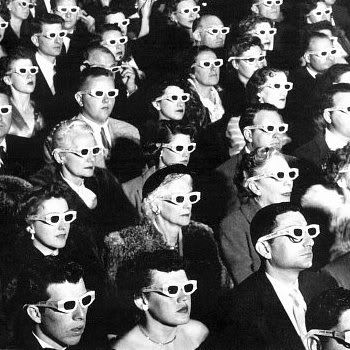 Oh sure, at one point a Despicable Me character looked as if it was suspended right in front of me and I could reach out and squish its little animated head if the mood struck me. But that effect came and went in about ten seconds. For the remaining 89 minutes and 50 seconds of the movie, I saw absolutely nothing that merited cheap glasses and 15 bucks.
What exactly has changed about 3D movies since the 1950s? I pulled the accompanying photo off Google Images and it appears this audience had the same technology, except that the glasses were cardboard as opposed to plastic. The audience also had shorter hair and fewer tattoos than the moviegoers watching Despicable Me. But the technology itself? Heck, my mother, now in her mid-70s, told me stories of going to see 3D movies and literally jumping out of her seat at the effects.
I jumped from my seat exactly once during Despicable Me. It was just after I said to my kids, “Time to go.”
In 1974 I went to see Earthquake with some junior high school buddies. What lured us to the theatre was not the chance to see buildings falling over. It was the tagline that accompanied the ads: “In Sensurround.”
Nobody explained what Sensurround was. It was just supposed to make the earthquake experience more real to the moviegoer. In 2010, as our country continues to slog through a recession, I’m not sure I want movies to be more real. I’m looking forward to seeing Wall Street 2 this Fall but not if I’m going to come home and find my IRA has been mysteriously liquidated.
But in 1974 I sat in my seat and awaited the Sensurround effects. Less than 30 minutes into the movie, a “rat a tat tat” sound shook the theater at ear splitting decibels. It was if a machine gun battle was taking place in the theatre’s rear.
I DID jump from my seat and so did my buddies. Meanwhile, Charlton Heston barely escaped being buried under a toppling bridge.
Sensurround never really took off but isn’t it strange that, nearly 40 years later, I remembered that word and the effects it produced without having to consult either Wikipedia or Google?
Now I’m raising my kids in a world containing text messaging, mobile apps, on line everything and new technologies that truly are eye popping.
Yet it’s been a week since I saw Despicable Me and I’ve already forgotten what the movie was about. I certainly don’t remember any 3D effects.
Maybe “jaw dropping 4D” will be different.
At first this seemed like a better result than our original intent. At five years old my oldest had become “self sufficient,” a term many parents use if they don’t feel like actually playing with their kids if there is something good on ESPN.
Just put Disney Channel on in the other room and plop him down on the couch. He’s self sufficient.
In our case, “self sufficient” meant that the oldest could dress herself, use silverware, drink from a cup and generally get through the day without a 911 call, leaving us free to tend to the younger daughter’s every need.
But, as kids grow, you realize that siblings five years apart aren’t that much easier to please than children 55 years apart when it comes to providing activities that appeal to everybody. Nowhere is this more evident than when choosing a movie.
A few Fridays ago, my wife Sue was in the midst of her annual Vegas girlfriend trip. She has been going to Sin City at least once a year, sans me, since we’ve been married and I function quite well without her. But somehow word gets out that I’m home alone with the kids, causing relatives and neighbors I never knew existed to offer me dinner invitations, school pickups and activity drop offs. Sue is both amazed and exceedingly jealous when I casually mention that others have stepped up to assist me during her absence, as well she should be. I spend at least 50 nights a year away from home yet she is still awaiting the offer of a simple casserole.
So there we were one Friday, scanning the movie start times and trying to figure out what flick would appeal to a 13-year old soon-to-be eighth grader, her eight-year-old sister and their 47-year-old father. After rejecting Toy Story 3 (“we’ve already seen it”), Step Up 3 (“the first one was good but the second one was dumb”), and Cats and Dogs (“Dad, we don’t like cats”), we settled on Despicable Me. A quick check of the listings revealed that it was showing on two screens at the nearby multiplex.
Why two? Because one theatre was showing the movie in 3D. Not just 3D, mind you, but “EYE POPPING 3D,” the term being bantered around for seemingly every movie these days.
Naturally the start times for the “non eye popping 3D” version did not agree with the Schwem’s busy schedule. In other words, Dad couldn’t get dinner on the table fast enough. So we showed up at the multiplex a mere 10 minutes before the 3D version began. Immediately I noticed one thing about the movie that truly was eye popping: the price. Tickets for Despicable Me in 3D were $15 each as opposed to $9 for the regular and apparently boring version. Now I was out $45 and we hadn’t even reached the concession stand. An additional $20 later, we entered the theatre, dipped our now buttery hands into the barrel of used 3D glasses, and settled in.
First we had to endure the mandatory 25 minutes of “coming attractions.” Not surprisingly, five soon-to-be-released movies were promised in “eye popping 3D.” Most also starred “the voice of Tina Fey.” I made a mental note to start conserving funds in case my daughters wanted to attend any more movies in the next six months.
Eventually the attractions were over and Despicable Me began. With my glasses firmly, and uncomfortably, perched on my nose, I waited for the “eye popping” 3D effects that cost an extra six bucks per ticket.
I am still waiting.
What exactly has changed about 3D movies since the 1950s? I pulled the accompanying photo off Google Images and it appears this audience had the same technology, except that the glasses were cardboard as opposed to plastic. The audience also had shorter hair and fewer tattoos than the moviegoers watching Despicable Me. But the technology itself? Heck, my mother, now in her mid-70s, told me stories of going to see 3D movies and literally jumping out of her seat at the effects.
I jumped from my seat exactly once during Despicable Me. It was just after I said to my kids, “Time to go.”
In 1974 I went to see Earthquake with some junior high school buddies. What lured us to the theatre was not the chance to see buildings falling over. It was the tagline that accompanied the ads: “In Sensurround.”
Nobody explained what Sensurround was. It was just supposed to make the earthquake experience more real to the moviegoer. In 2010, as our country continues to slog through a recession, I’m not sure I want movies to be more real. I’m looking forward to seeing Wall Street 2 this Fall but not if I’m going to come home and find my IRA has been mysteriously liquidated.
But in 1974 I sat in my seat and awaited the Sensurround effects. Less than 30 minutes into the movie, a “rat a tat tat” sound shook the theater at ear splitting decibels. It was if a machine gun battle was taking place in the theatre’s rear.
I DID jump from my seat and so did my buddies. Meanwhile, Charlton Heston barely escaped being buried under a toppling bridge.
Sensurround never really took off but isn’t it strange that, nearly 40 years later, I remembered that word and the effects it produced without having to consult either Wikipedia or Google?
Now I’m raising my kids in a world containing text messaging, mobile apps, on line everything and new technologies that truly are eye popping.
Yet it’s been a week since I saw Despicable Me and I’ve already forgotten what the movie was about. I certainly don’t remember any 3D effects.
Maybe “jaw dropping 4D” will be different.
Sunday, August 01, 2010
Like, what are you saying?
like
transitive verb
1 – to be suitable or agreeable to
2 – to feel attraction toward or take pleasure in
3 – every other word out of my daughter’s mouth
I love my kids. I truly do. I encourage communication with them. But despite the fact that they are my world and I heap affection on them at every moment, I hesitate to say that I “like” them. For, if I hear that word one more time, I’m like going to scream.
I am a stand-up comedian by trade. My profession relies on audience approval. Every time I walk on stage, I hope the audience will like me. But I don’t want them to “like, like me.”
Seriously, when did the word “like,” which has multiple meanings as evidenced by the above definitions taken directly from Merriam-Webster’s on-line dictionary, become the most overused and grating word in the English language?
Does anybody know? Perhaps I should ask country music superstar Carrie Underwood who, during a recent Today Show appearance, talked about like her marriage and like her upcoming tour and like her charity work and like the changes on American Idol. I have always liked Carrie Underwood, believing her music and her personality suitable for my kids. My oldest, now thirteen, even met her backstage before a concert and Carrie was exceptionally gracious and accommodating. But she also seemed in a bit of a hurry. Note to Carrie: If you eliminate “like” from your vocabulary, think of the extra time you’ll have!
At some point in history, “like” burst onto the scene and refused to leave, much like karaoke. The difference is that karaoke eventually ENDS. A rendition of "Summer Nights" from Grease, sung by two fully-intoxicated women at a bar, is mercifully over after three minutes. Stories peppered with “like” seem to go on forever. If you don’t believe me, come to one of my daughter’s sleepovers, where you will be treated to dialogue like this:
“So I’m like sitting there and then she comes over and she’s like, ‘Emily, like are you going to ask him?’ And I’m like, ‘No way.’ So she’s like, ‘Oh, just do it. Like, maybe he’ll say yes.’ And I’m like, ‘You are so weird. Why would I like do that?’ And she’s like, ‘Because you’re like so that person.’ And I’m like, ‘I am not.’ And she’s like, ‘Okay, maybe you’re not like that person. But you’re definitely like THAT person.’”
The story resulted in gales of laughter and squeals from the girls. Moments after typing it on my PC, my spelling and punctuation tool exploded in frustration.
Being a history buff, I looked at some famous quotes and speeches over the years, hoping to see when "like" began popping up. I immediately eliminated the Revolutionary War era because nowhere did I ever read Patrick Henry boldly stating, “Like give me liberty or give me like death.”
Even during the Civil War, when our country split in two and couldn’t agree on ANYTHING, both sides were apparently united in their belief that “like” was not “liked” when it came to speech. Abraham Lincoln used the word exactly ZERO times in his Gettysburg Address, a fact quickly verified by the “find and replace” tool on my web browser. Frankly, I was surprised. After all, wasn’t the message of that speech about creating a unified nation? In other words, get along and LIKE each other! But Lincoln chose to use more eloquent prose and that’s probably a good thing. Somehow, the phrase, “Like four score and seven years ago, like our fathers brought forth on this continent, like a new nation, conceived in like Liberty, and dedicated to the proposition that all men are like created equal” doesn’t move me.
Fast forward nearly 100 years and still no sign of the word in our culture. When the Japanese rained bombs down on Pearl Harbor, President Franklin Roosevelt did not deliver the news by stating, “December 7, 1941. A day that will, like, live in infamy.”
I would have thought that "like" would have made its appearance in the late 1960s. After all, most of the country was high and unaware of what was coming out of their mouths, never mind what was going into same mouths. Yet I listened over and over to the audio feed of Neil Armstrong’s historic moon landing. Not once did I hear him say, “That’s like one small step for man, one like giant leap for mankind.”
Eventually I gave up, unable to find any historical quotes of significance peppered with “like.” Now I can’t even open a magazine without seeing the hated word in print numerous times. Journalists, in their attempts to quote subjects accurately and avoid being sued for libel, have apparently decided it’s best to include the word. A recent Rolling Stone interview with Leonardo DiCaprio netted the following quote:
“My mom always says I’m exaggerating and I’m like, ‘Mom, you are sorely mistaken.”
During a recent movie outing with my girls, we were treated to a trailer from Disney’s upcoming Tangled. Suddenly the following text flashed across the screen:
She’s been grounded like…forever.”
When I log onto Facebook, I'm immediately asked if I want to "like" everything from Chipotle’s restaurant to a sketch comedy revue called Pop Vulture. I LIKED it better when Facebook wanted to know if I was a “fan” of a particular page. Of course my daugher’s friends would have announced that they were “like fans of Justin Bieber.”
Is it possible to get away from "like?" Do the deaf use it in sign language? If so, I hope the sign is very simple – and painful. If there is indeed no sign for "like," might I suggest sticking an index finger into one’s eyeball? Perhaps that would keep deaf teenagers from using the word ad nauseum.
How can we stop the "like" epidemic? Whom do we ask? Certainly not our children, who would most likely reply, “Like huh?”
Desperate times call for desperate measures. In college I used to watch old Bob Newhart episodes with fraternity brothers and play a drinking game called “Hi Bob.” The rules were simple: Watch the show with a full beer in hand. Every time a character said, “Hi Bob,” or some form thereof, take a drink. It’s amazing how looped one can get during a 30-minute sitcom.
Maybe utterances of the word “like” should have similar consequences. Note I said similar since the prime offenders of “like overload” are not of legal drinking age, Carrie Underwood notwithstanding. But they could still face penalties. For every utterance of "like" that did not pertain to agreement or attraction, no iPod or iTunes for a week.
Somebody like alert Steve Jobs.
transitive verb
1 – to be suitable or agreeable to
2 – to feel attraction toward or take pleasure in
3 – every other word out of my daughter’s mouth
I love my kids. I truly do. I encourage communication with them. But despite the fact that they are my world and I heap affection on them at every moment, I hesitate to say that I “like” them. For, if I hear that word one more time, I’m like going to scream.
I am a stand-up comedian by trade. My profession relies on audience approval. Every time I walk on stage, I hope the audience will like me. But I don’t want them to “like, like me.”
Seriously, when did the word “like,” which has multiple meanings as evidenced by the above definitions taken directly from Merriam-Webster’s on-line dictionary, become the most overused and grating word in the English language?
Does anybody know? Perhaps I should ask country music superstar Carrie Underwood who, during a recent Today Show appearance, talked about like her marriage and like her upcoming tour and like her charity work and like the changes on American Idol. I have always liked Carrie Underwood, believing her music and her personality suitable for my kids. My oldest, now thirteen, even met her backstage before a concert and Carrie was exceptionally gracious and accommodating. But she also seemed in a bit of a hurry. Note to Carrie: If you eliminate “like” from your vocabulary, think of the extra time you’ll have!
At some point in history, “like” burst onto the scene and refused to leave, much like karaoke. The difference is that karaoke eventually ENDS. A rendition of "Summer Nights" from Grease, sung by two fully-intoxicated women at a bar, is mercifully over after three minutes. Stories peppered with “like” seem to go on forever. If you don’t believe me, come to one of my daughter’s sleepovers, where you will be treated to dialogue like this:
“So I’m like sitting there and then she comes over and she’s like, ‘Emily, like are you going to ask him?’ And I’m like, ‘No way.’ So she’s like, ‘Oh, just do it. Like, maybe he’ll say yes.’ And I’m like, ‘You are so weird. Why would I like do that?’ And she’s like, ‘Because you’re like so that person.’ And I’m like, ‘I am not.’ And she’s like, ‘Okay, maybe you’re not like that person. But you’re definitely like THAT person.’”
The story resulted in gales of laughter and squeals from the girls. Moments after typing it on my PC, my spelling and punctuation tool exploded in frustration.
Being a history buff, I looked at some famous quotes and speeches over the years, hoping to see when "like" began popping up. I immediately eliminated the Revolutionary War era because nowhere did I ever read Patrick Henry boldly stating, “Like give me liberty or give me like death.”
Even during the Civil War, when our country split in two and couldn’t agree on ANYTHING, both sides were apparently united in their belief that “like” was not “liked” when it came to speech. Abraham Lincoln used the word exactly ZERO times in his Gettysburg Address, a fact quickly verified by the “find and replace” tool on my web browser. Frankly, I was surprised. After all, wasn’t the message of that speech about creating a unified nation? In other words, get along and LIKE each other! But Lincoln chose to use more eloquent prose and that’s probably a good thing. Somehow, the phrase, “Like four score and seven years ago, like our fathers brought forth on this continent, like a new nation, conceived in like Liberty, and dedicated to the proposition that all men are like created equal” doesn’t move me.
Fast forward nearly 100 years and still no sign of the word in our culture. When the Japanese rained bombs down on Pearl Harbor, President Franklin Roosevelt did not deliver the news by stating, “December 7, 1941. A day that will, like, live in infamy.”
I would have thought that "like" would have made its appearance in the late 1960s. After all, most of the country was high and unaware of what was coming out of their mouths, never mind what was going into same mouths. Yet I listened over and over to the audio feed of Neil Armstrong’s historic moon landing. Not once did I hear him say, “That’s like one small step for man, one like giant leap for mankind.”
Eventually I gave up, unable to find any historical quotes of significance peppered with “like.” Now I can’t even open a magazine without seeing the hated word in print numerous times. Journalists, in their attempts to quote subjects accurately and avoid being sued for libel, have apparently decided it’s best to include the word. A recent Rolling Stone interview with Leonardo DiCaprio netted the following quote:
“My mom always says I’m exaggerating and I’m like, ‘Mom, you are sorely mistaken.”
During a recent movie outing with my girls, we were treated to a trailer from Disney’s upcoming Tangled. Suddenly the following text flashed across the screen:
She’s been grounded like…forever.”
When I log onto Facebook, I'm immediately asked if I want to "like" everything from Chipotle’s restaurant to a sketch comedy revue called Pop Vulture. I LIKED it better when Facebook wanted to know if I was a “fan” of a particular page. Of course my daugher’s friends would have announced that they were “like fans of Justin Bieber.”
Is it possible to get away from "like?" Do the deaf use it in sign language? If so, I hope the sign is very simple – and painful. If there is indeed no sign for "like," might I suggest sticking an index finger into one’s eyeball? Perhaps that would keep deaf teenagers from using the word ad nauseum.
How can we stop the "like" epidemic? Whom do we ask? Certainly not our children, who would most likely reply, “Like huh?”
Desperate times call for desperate measures. In college I used to watch old Bob Newhart episodes with fraternity brothers and play a drinking game called “Hi Bob.” The rules were simple: Watch the show with a full beer in hand. Every time a character said, “Hi Bob,” or some form thereof, take a drink. It’s amazing how looped one can get during a 30-minute sitcom.
Maybe utterances of the word “like” should have similar consequences. Note I said similar since the prime offenders of “like overload” are not of legal drinking age, Carrie Underwood notwithstanding. But they could still face penalties. For every utterance of "like" that did not pertain to agreement or attraction, no iPod or iTunes for a week.
Somebody like alert Steve Jobs.
Tuesday, March 23, 2010
So many friends, so little time
The boxes stood side by side on my computer screen as I sipped my morning coffee. My mouse hovered between them.
Confirm Ignore
Clicking the first box would mean my Facebook friend count would rise to 240, a paltry number by Facebook standards considering that others in my Facebook network had thousands of “friends” in their accounts. Still, it was far more than I had acquired in my real life.
I had seven friends in common with Linda, the requestee. All were comedians like myself. Linda was a part time comedian, according to her profile. Still, I had no idea who she was.
I continued staring at the boxes, pondering Linda’s fate. I asked myself, what would be the harm in friending her? I still don’t know what happens when a friend request gets denied on Facebook. For all I know, the lonely jilted person gets an email or text message stating, “Greg doesn’t want to be your friend. Here’s his cell phone number and home address in case you want to discuss it further. Oh, and here’s the name of an attorney in case you want to sue Greg for pain, suffering and mental anguish.”
I was willing to take that chance. I clicked “ignore.” Linda would not become part of my Facebook contingent and my friend count thus remains at 239.
I hope her feelings aren’t hurt. Maybe Linda was somebody I actually knew yet just couldn’t place. Her profile photo didn’t exactly help matters as it featured a very grainy image of a woman kissing a man. At least I think it was a man. The photo was really grainy.
Yet I am sensing a mood shift in the Facebook community. I keep reading that, if Facebook were a country, it would be the world’s fourth largest. I’m not sure how residents of Indonesia, currently the world’s fourth largest country, feel about this but chances are they are discussing it on their Facebook walls.
But the Facebook population explosion appears to have slowed. Like me, people are no longer randomly clicking “confirm” to every Facebook friend request that appears onscreen. Those that do are starting to regret it, as evidenced by some of the recent wall posts I’ve read:
Is it just me or does everyone get too many event invites? Time to delete some names.
To all my FB friends: I friended you because I care about you and your thoughts, NOT Farmville or Mafia or other third party apps
The previous post was written by a friend who is a member of the following Facebook “groups”:
50,000 Against Healthcare Bill in the next 72 Hours
I Bet We Can Find 1,000,000+ people who Disapprove of the Health Care Bill
304,059,724 Against Obama’s Healthcare Takeover
Repeal Obamacare
My friend is nothing if not optimistic.
When I entered Northwestern University in 1980, I attended fraterntity Rush Week, a five day drinking binge where seemingly EVERYBODY in EVERY HOUSE I entered wanted to be my friend. Thirty seconds after opening a door adorned with Greek letters, members wearing shirts with those same letters approached me from all sides and offered me red plastic cups filled to the rim with keg beer or a sweet-tasting punch, made with a combination of grain alcohol and moonshine whiskey, and bearing the name of the frat somewhere in the title.
Here Greg, try some Fiji Fire.
Careful. This is Delta Devil
Want a Sigma Slam?
With drink in hand, they let me steer the conversation any direction I pleased. Even if I chose to talk about the chemical composition of cement, they appeared interested.
Eventually I chose Phi Kappa Sigma, known around campus as “The Skull House” and creators of “Skull Juice,” a drink so toxic, it could have passed as paint thinner. Becoming a Phi Kap was a decision I never regretted even though I soon realized that not all the Phi Kap upperclassmen found me as interesting as they did during Rush Week. Factions formed, members occasionally allied over pertinent fraternity issues, (like whether the women of Delta Gamma would be more impressed if we served Strawberry Daiquiris or Pina Coladas at the mixer. Turns out the answer was, “neither”) and every member, myself included, had at least one “what did I see in these guys and what did they see in me?” moment.
Facebook, I’m realizing, is nothing more than the world’s largest fraternity. The only difference is that you can remove people at any time, something we couldn’t do at Phi Kappa Sigma unless their dues checks continually bounced.
I have yet to defriend any Facebook friends although I am starting to profile them, much the same way that federal agencies profile suspected terrorists. So far I have identified several:
The Meteorologist: This person apparently joined Facebook solely so he could provide weather updates to the entire Facebook community. My meteorological friend has posted the following in the last week alone:
The sun is out and the snow is melting
Yesterday temps in the 60s. Today, 2 inches of snow on the ground
Loving this brief warm spell we are having
Loving the warm weather. Melt snow…MELT
The Godfather - Someone who spends waaaaay too much time playing the aforementioned Mafia Wars, an exceptionally popular Facebook game that I refuse to become part of because I don’t want the following posts to clutter up other friends’ walls:
___ is working hard to finish the Loot the Police Impound Lot job and is in need of a whole lot of Armored Trucks from their Mafia!
_____ needs help to take on local motorcycle thugs in Mafia Wars.
The Crop Duster – The same person except that their life revolves around Farmville, another third party app that has something to do with cute little animals and, unlike Mafia Wars is void of violence. I have yet to receive a post stating that 500 cows were slaughtered in Farmville.
The Joiner - That friend who encourages you to hug your son (even if you are childless or, like me, produced only daughters), applaud the accomplishments of someone with Down Syndrome, forward a political message about global warming or change your profile picture to your favorite Mad Men character - just for a day. These people apparently never heard the “If-your-friend-jumped-off-a-bridge-would-you-do-it too?” speech.
Top Chef – The friend who shares about-to-be-consumed meals with everybody – usually with photos. Two of my friends have, in the past week, prepared and/or eaten buttermilk marinated chicken, salmon ber blanc with capers and blackened fish over coastal salsa and Belgian endive. While these recipes all sound delicious, reading about and viewing the finished product simply wants to make me get up and head to the refrigerator.
The Exercise Freak – This friend wouldn’t be caught dead eating buttermilk marinated chicken because he or she is too busy posting exercise updates. To all those people who tell me about their recently completed 20-mile run through the hills of some town with an Indian name, remember that running enthusiast Jim Fixx bragged about his hobby in a best selling book - and died after jogging.
If you’re reading this and find yourself in one of these categories, don’t worry. I don’t plan to defriend anybody as I truly enjoy Facebook’s ability to help me reconnect with old friends and meet new ones. Heck, I’ve probably been guilty of many “who cares” posts myself. So, Farmville and Mafia Wars participants aside, keep sending me weather updates, menu schedules, exercise regimens and political rants.
Just not every hour.
Confirm Ignore
Clicking the first box would mean my Facebook friend count would rise to 240, a paltry number by Facebook standards considering that others in my Facebook network had thousands of “friends” in their accounts. Still, it was far more than I had acquired in my real life.
I had seven friends in common with Linda, the requestee. All were comedians like myself. Linda was a part time comedian, according to her profile. Still, I had no idea who she was.
I continued staring at the boxes, pondering Linda’s fate. I asked myself, what would be the harm in friending her? I still don’t know what happens when a friend request gets denied on Facebook. For all I know, the lonely jilted person gets an email or text message stating, “Greg doesn’t want to be your friend. Here’s his cell phone number and home address in case you want to discuss it further. Oh, and here’s the name of an attorney in case you want to sue Greg for pain, suffering and mental anguish.”
I was willing to take that chance. I clicked “ignore.” Linda would not become part of my Facebook contingent and my friend count thus remains at 239.
I hope her feelings aren’t hurt. Maybe Linda was somebody I actually knew yet just couldn’t place. Her profile photo didn’t exactly help matters as it featured a very grainy image of a woman kissing a man. At least I think it was a man. The photo was really grainy.
Yet I am sensing a mood shift in the Facebook community. I keep reading that, if Facebook were a country, it would be the world’s fourth largest. I’m not sure how residents of Indonesia, currently the world’s fourth largest country, feel about this but chances are they are discussing it on their Facebook walls.
But the Facebook population explosion appears to have slowed. Like me, people are no longer randomly clicking “confirm” to every Facebook friend request that appears onscreen. Those that do are starting to regret it, as evidenced by some of the recent wall posts I’ve read:
Is it just me or does everyone get too many event invites? Time to delete some names.
To all my FB friends: I friended you because I care about you and your thoughts, NOT Farmville or Mafia or other third party apps
The previous post was written by a friend who is a member of the following Facebook “groups”:
50,000 Against Healthcare Bill in the next 72 Hours
I Bet We Can Find 1,000,000+ people who Disapprove of the Health Care Bill
304,059,724 Against Obama’s Healthcare Takeover
Repeal Obamacare
My friend is nothing if not optimistic.
When I entered Northwestern University in 1980, I attended fraterntity Rush Week, a five day drinking binge where seemingly EVERYBODY in EVERY HOUSE I entered wanted to be my friend. Thirty seconds after opening a door adorned with Greek letters, members wearing shirts with those same letters approached me from all sides and offered me red plastic cups filled to the rim with keg beer or a sweet-tasting punch, made with a combination of grain alcohol and moonshine whiskey, and bearing the name of the frat somewhere in the title.
Here Greg, try some Fiji Fire.
Careful. This is Delta Devil
Want a Sigma Slam?
With drink in hand, they let me steer the conversation any direction I pleased. Even if I chose to talk about the chemical composition of cement, they appeared interested.
Eventually I chose Phi Kappa Sigma, known around campus as “The Skull House” and creators of “Skull Juice,” a drink so toxic, it could have passed as paint thinner. Becoming a Phi Kap was a decision I never regretted even though I soon realized that not all the Phi Kap upperclassmen found me as interesting as they did during Rush Week. Factions formed, members occasionally allied over pertinent fraternity issues, (like whether the women of Delta Gamma would be more impressed if we served Strawberry Daiquiris or Pina Coladas at the mixer. Turns out the answer was, “neither”) and every member, myself included, had at least one “what did I see in these guys and what did they see in me?” moment.
Facebook, I’m realizing, is nothing more than the world’s largest fraternity. The only difference is that you can remove people at any time, something we couldn’t do at Phi Kappa Sigma unless their dues checks continually bounced.
I have yet to defriend any Facebook friends although I am starting to profile them, much the same way that federal agencies profile suspected terrorists. So far I have identified several:
The Meteorologist: This person apparently joined Facebook solely so he could provide weather updates to the entire Facebook community. My meteorological friend has posted the following in the last week alone:
The sun is out and the snow is melting
Yesterday temps in the 60s. Today, 2 inches of snow on the ground
Loving this brief warm spell we are having
Loving the warm weather. Melt snow…MELT
The Godfather - Someone who spends waaaaay too much time playing the aforementioned Mafia Wars, an exceptionally popular Facebook game that I refuse to become part of because I don’t want the following posts to clutter up other friends’ walls:
___ is working hard to finish the Loot the Police Impound Lot job and is in need of a whole lot of Armored Trucks from their Mafia!
_____ needs help to take on local motorcycle thugs in Mafia Wars.
The Crop Duster – The same person except that their life revolves around Farmville, another third party app that has something to do with cute little animals and, unlike Mafia Wars is void of violence. I have yet to receive a post stating that 500 cows were slaughtered in Farmville.
The Joiner - That friend who encourages you to hug your son (even if you are childless or, like me, produced only daughters), applaud the accomplishments of someone with Down Syndrome, forward a political message about global warming or change your profile picture to your favorite Mad Men character - just for a day. These people apparently never heard the “If-your-friend-jumped-off-a-bridge-would-you-do-it too?” speech.
Top Chef – The friend who shares about-to-be-consumed meals with everybody – usually with photos. Two of my friends have, in the past week, prepared and/or eaten buttermilk marinated chicken, salmon ber blanc with capers and blackened fish over coastal salsa and Belgian endive. While these recipes all sound delicious, reading about and viewing the finished product simply wants to make me get up and head to the refrigerator.
The Exercise Freak – This friend wouldn’t be caught dead eating buttermilk marinated chicken because he or she is too busy posting exercise updates. To all those people who tell me about their recently completed 20-mile run through the hills of some town with an Indian name, remember that running enthusiast Jim Fixx bragged about his hobby in a best selling book - and died after jogging.
If you’re reading this and find yourself in one of these categories, don’t worry. I don’t plan to defriend anybody as I truly enjoy Facebook’s ability to help me reconnect with old friends and meet new ones. Heck, I’ve probably been guilty of many “who cares” posts myself. So, Farmville and Mafia Wars participants aside, keep sending me weather updates, menu schedules, exercise regimens and political rants.
Just not every hour.
Saturday, February 13, 2010
I can't get no...satisfaction
Several months ago, I blogged about the Kindle, the digital book reader and brainchild of Amazon.com. At the time I was melancholy that yet another electronic gadget was replacing an age-old institution, in this case “the book.”
Suddenly, however, I am feeling sorry for this device because, with the recent announcement of the Apple iPad, the Kindle is being derided by bloggers and technology experts alike because of its singular function – it only holds books.
My wife bought me a Kindle for Christmas and, I have to admit, I flip-flopped over its benefits. The idea that a book had to be recharged bothered me. Leave it to Amazon to give teenagers one more excuse for failing to complete their homework.
My book died. What was I SUPPOSED to do?
The Kindle came with a 30-day money back guarantee and, as the 29th day approached, I was still wavering. Meanwhile I had already downloaded and completed two books and four Sunday New York Times, while taking advantage of countless free sample chapters. The “sample chapter” feature is kind of cool as it eliminates the need to stand in bookstores for hours, reading portions of every title on the shelves while staff members wonder if you are ever going to actually buy something. Blockbuster needs to do the same with movies.
I decided to keep the Kindle. I’m a voracious reader by nature, preferring books over movies and music while traveling so it seemed like a viable purchase. I was satisfied with my decision for exactly 72 hours. That’s when Apple CEO Steve Jobs strode onto a San Francisco stage in his trademark black turtleneck and jeans (seriously, why do these tech billionaires feel compelled to wear a single ensemble each time they appear in public? I have yet to see Bill Gates in anything other than a blue button down shirt and navy sweater. He must own close to 1,000 of each), and unveiled the iPad. As far as I could tell, it was perfect for users who wanted either a bigger iPhone or a smaller Macbook but couldn’t decide.
The iPad, Jobs giddily explained, could read books and newspapers but could do so much more! It could play music, surf the Web, send email, schedule appointments and store contacts. The invited guests (how does one get an iPad invitation incidentally?) oohed and aahed as Jobs himself played with the device onstage while silently praying that nothing malfunctioned. (Anyone remember Gates’ Windows 98 demonstration?) Suddenly Kindle users like me were being viewed alongside the segment of our society that still adjusts television reception with rabbit ears.
The iPad’s accolades continued until the launch ended, at which time those lucky enough to get their hands on a working iPad really had a chance to digest the device’s features. Naturally, the criticisms started seconds later, most notably that the iPad did not contain a camera.
Horrors!
When did it become a requirement for everybody to have photographic capability at all times? Americans spend an average of nine hours a day working and seven hours a day sleeping. We’re not exactly walking photo opps.
The iPad also was unable to play Flash video. How could Apple have neglected such an obvious feature, the critics wondered? Suddenly Jobs’ innovation was headed to the scrap heap before it was even available for purchase.
I always thought it would be cool to invent something. Now, I feel all fledgling Ben Franklins who are spending countless hours in basements, labs or garages creating the next great whatever, are simply setting themselves up for criticism from our never satisfied society. If Thomas Edison invented the lightbulb today, a blogger would write, “What? No dimmer? How does TE expect to set the proper mood without this obvious feature?”
I’m going to keep my Kindle and marvel at the face that it can download War and Peace in under a minute. I’m going to read it on the plane and not bemoan the fact that it can’t take a photo of another passenger mid-flight. In short I’m going to be satisfied.
Of course, I don’t own a Toyota, which we are now finding out, was most likely manufactured without brakes. That would be something to complain about.
Suddenly, however, I am feeling sorry for this device because, with the recent announcement of the Apple iPad, the Kindle is being derided by bloggers and technology experts alike because of its singular function – it only holds books.
My wife bought me a Kindle for Christmas and, I have to admit, I flip-flopped over its benefits. The idea that a book had to be recharged bothered me. Leave it to Amazon to give teenagers one more excuse for failing to complete their homework.
My book died. What was I SUPPOSED to do?
The Kindle came with a 30-day money back guarantee and, as the 29th day approached, I was still wavering. Meanwhile I had already downloaded and completed two books and four Sunday New York Times, while taking advantage of countless free sample chapters. The “sample chapter” feature is kind of cool as it eliminates the need to stand in bookstores for hours, reading portions of every title on the shelves while staff members wonder if you are ever going to actually buy something. Blockbuster needs to do the same with movies.
I decided to keep the Kindle. I’m a voracious reader by nature, preferring books over movies and music while traveling so it seemed like a viable purchase. I was satisfied with my decision for exactly 72 hours. That’s when Apple CEO Steve Jobs strode onto a San Francisco stage in his trademark black turtleneck and jeans (seriously, why do these tech billionaires feel compelled to wear a single ensemble each time they appear in public? I have yet to see Bill Gates in anything other than a blue button down shirt and navy sweater. He must own close to 1,000 of each), and unveiled the iPad. As far as I could tell, it was perfect for users who wanted either a bigger iPhone or a smaller Macbook but couldn’t decide.
The iPad, Jobs giddily explained, could read books and newspapers but could do so much more! It could play music, surf the Web, send email, schedule appointments and store contacts. The invited guests (how does one get an iPad invitation incidentally?) oohed and aahed as Jobs himself played with the device onstage while silently praying that nothing malfunctioned. (Anyone remember Gates’ Windows 98 demonstration?) Suddenly Kindle users like me were being viewed alongside the segment of our society that still adjusts television reception with rabbit ears.
The iPad’s accolades continued until the launch ended, at which time those lucky enough to get their hands on a working iPad really had a chance to digest the device’s features. Naturally, the criticisms started seconds later, most notably that the iPad did not contain a camera.
Horrors!
When did it become a requirement for everybody to have photographic capability at all times? Americans spend an average of nine hours a day working and seven hours a day sleeping. We’re not exactly walking photo opps.
The iPad also was unable to play Flash video. How could Apple have neglected such an obvious feature, the critics wondered? Suddenly Jobs’ innovation was headed to the scrap heap before it was even available for purchase.
I always thought it would be cool to invent something. Now, I feel all fledgling Ben Franklins who are spending countless hours in basements, labs or garages creating the next great whatever, are simply setting themselves up for criticism from our never satisfied society. If Thomas Edison invented the lightbulb today, a blogger would write, “What? No dimmer? How does TE expect to set the proper mood without this obvious feature?”
I’m going to keep my Kindle and marvel at the face that it can download War and Peace in under a minute. I’m going to read it on the plane and not bemoan the fact that it can’t take a photo of another passenger mid-flight. In short I’m going to be satisfied.
Of course, I don’t own a Toyota, which we are now finding out, was most likely manufactured without brakes. That would be something to complain about.
Tuesday, December 01, 2009
Busted at a Door Buster Sale

I recently read the late David Foster Wallace’s essay A Supposedly Fun Thing I’ll Never Do Again. In it Wallace hilariously skewers anything and everything he encountered while sailing aboard a cruise ship.
I wish Wallace had lived long enough to pen his opinions of a post-Thanksgiving Door Buster sale.
The difference between a cruise ship and a Door Buster sale is that cruise ships are at least perceived as enjoyable, even if Wallace discovered otherwise. I don’t believe anybody in Western civilization has ever returned from a Door Buster sale and announced, “That was fun.”
Door Busters, also known as Black Friday sales because they take place the day (I’m sorry, the ungodly early morning) following Thanksgiving, were invented solely because every retail establishment, including those which sell nothing but live bait, decided that sales figures for the entire year should hinge on the single day that follows gluttony, football and tense relations with relatives.
Door Buster sales also exist so television news crews have something to show on a slow news day. Invariably these “packages” (a term from my old TV reporting days) contain only images of fully-grown adults acting like a combination of toddlers and gang bangers as they violently fight over whatever item the offending retailer chose to put on sale for 50 percent off just hours after the Thanksgiving dishes had been cleared away.
Occasionally this YouTube display of news turns into actual news; witness 2008 when security guard Jdimytai Damour was trampled TO DEATH at a Long Island Wal-Mart as customers surged forward to purchase, among other things, a $28 Bissel Compact Upright Vacuum. On that morning, Damour’s first Black Friday job responsibility - and ultimately his last – was to simply open the door.
In spite of Damour’s fate, and similar occurrences with slightly less horrific results (some shoppers merely suffer broken bones in exchange for a DVD player), retailers continue this macabre practice. In the event of mayhem, their savvy marketing departments already have prepared statements that read with all the sincerity of those recited by professional athletes after being caught with steroids, handguns, stolen stereo equipment or all three.
We truly regret this tragic and unfortunate incident. We are cooperating with authorities and are confident that, in time, all the facts will come out. Until then, COME TO OUR EARLY BIRD 4 A.M. SALE! SIXTY-INCH FLAT SCREEN PLASMA TELEVISIONS ONLY $29.99. ONLY THREE IN STOCK!
On the day before Thanksgiving my wife scours the ads – both print and on line – to see if any Door Buster sale items match anything on our daughters’ Christmas lists. Thankfully that has never been the case.
Until this year.
This year my 12-year-old’s Christmas wishes included something known as Wii Fit. I’m still not sure what it is although the Wii homepage promises Wii Fit will improve balance, body mass index and “body control.”
If Door Buster shoppers had an ounce of body control, Mr. Damour might still be alive.
Normally $90, a store called Meijer had priced Wii Fit at $44.99 on Thanksgiving morning. That’s right, Meijer, one of those stores with an identity crisis (groceries to the right, snow tires to the left, thermal underwear and Venetian blinds straight ahead) was having a Black Thursday sale beginning at 6 a.m. Would I wait in line and get one, my wife asked?
Until now the only time I had ever stood in line longer than 30 minutes for anything was 1981 when Bruce Springsteen’s River Tour came through Chicago. I remember cueing up outside a record store four hours before tickets went on sale. Others ahead of me had obviously been there all night, judging by the sleeping bags and body odor. I spent the time chatting with fellow Springsteen fans, listening to his tunes, soaking in stories from Springsteen concert veterans and even sharing cheap wine from a hip flask.
I did score tickets that morning. Not great tickets mind you but tickets nonetheless. And the Boss did not disappoint. Twenty-eight years later, standing in line for something that improved body mass did not seem as appealing, even if I brought my own wine.
Yet I succumbed to my wife’s request with minimal complaining. Truth be known, I was looking forward to it. I’m an early riser by nature so the idea of setting a Thanksgiving alarm didn’t seem that ludicrous. Besides, the store was only ten minutes away from my health club. What better way to begin Turkey Day than by making my daughter happy, saving 50 bucks, and squeezing in a five mile run on the treadmill, thereby burning the calories in one scoop of mashed potatoes?
I awoke at 4:40 a.m. to the sound of rain pelting my bedroom windows. This was no surprise; Murphy’s Law specifically states that if one is going to wait outside a locked store for an inordinate amount of time, it MUST be raining, snowing, hailing or trembling due to an ill-timed earthquake. As I would soon find out, none of these calamities deter a Door Buster shopper.
I grabbed a sweatshirt, my Lands End winter coat, a ski hat and gloves and pulled out of my driveway at 4:50, armed with nothing more than a cup of coffee and my Door Buster game face. As I journeyed toward Meijer, I saw other cars on the road. Suffice it to say that, if you are in your car at 5 a.m. on Thanksgiving, it can be for one of two reasons:
· You are heading to a Door Buster Sale
· You need to dispose of a body…QUICKLY!
I live in a fairly safe neighborhood so I naturally assumed everybody who I passed or passed me fell into Category One. I also decided everybody was headed to Meijer in search of a Wii Fit, which made me press down a little more sharply on the gas pedal. I even cut off a few motorists, just to be safe.
At 5:05 a.m. I pulled into the Meijer parking lot, now three-quarters full with cars and one TV news truck. But where was the line? You know, the line of damp, sleepy customers preparing to trample the security guard? It did not exist. Instead, I saw people entering the store.
Did my wife misread the ad? Did Black Thursday actually start earlier than 6 a.m.? Had I failed before I even started?
Turns out, Meijer is open 24 hours so customers are free to come and go any time. But, as the ad promised, Black Thursday sales would not begin before 6 a.m. Customers could wait in line until then.
But which line? I sauntered to the electronics section at the rear of the store to find about 75 people standing in a surprisingly orderly fashion.
“Is this the Wii Fit line?” I asked the woman at the line’s rear.
“No, this is the iPod Nano line,” she replied.
“The Wii Fit line is two aisles over,” said a Meijer employee, gesturing randomly with one hand while pushing a shopping cart full of merchandise with his other.
Immediately I saw one thing about this Meijer place that I liked, namely foresight to split up the lines as opposed to lumping everybody in a single mass. Plus, we were inside! This was going to be a good day!
I took a hard right, counted two aisles, took a left and almost tripped over a patron seated on the floor. I discovered this gentleman was “Wii Fit Door Buster customer number one” and, for all I know, had been there since last Thanksgiving.
I followed the line down the aisle, where it made a gradual turn to the left and spilled over into the next aisle, containing school supplies. Half-heartedly counting in my head, I estimated there to be about 40 shoppers ahead of me. Judging from their body sizes all looked to be buying the Wii Fit for somebody other than themselves. Either that, or Wii Snack was also on sale.
I took a spot behind a woman who appeared to be about 60. A 50-something gentleman got in line behind me and the phalanx of Wii Fit hopefuls continued to grow. Within moments the line had increased by at least 30. As it multiplied, a rough-looking couple trudged to the end. I heard the woman exclaim loudly to her partner, “Baby there’s no way we’re gonna get one of these f*#@%g things.”
I was thinking the same thing but chose not to express it publicly.
At 5:15 a.m. a Meijer manager appeared halfway through the line and announced, to no one in particular, that the store only had 20 Wii Fits.
“You’re welcome to wait but I’m just telling you what we have,” he said, before disappearing.
At this point, my predicament read like a second grade math story problem: You are the 41st person in line for a toy. A grown up says there are only 20 toys available. Will you get a toy? Please show all work.
Common sense dictated that I should get out of line. But, upon hearing the employee’s grim news, exactly ZERO people moved from their places, including Mrs. Potty Mouth well behind me.
“These people must know something I don’t,” I thought. “If they’re not moving, I’m not moving.”
Door Buster shoppers are, if nothing else, eternally optimistic. I could almost hear them rationalizing how a Wii Fit could still be theirs.
“Maybe at least 10 people in front of me will all have fatal heart attacks in the next 45 minutes,” their faces appeared to say.
Or maybe 10 would get trampled once the clock struck six. I decided to wait.
A few minutes later the same Meijer employee appeared and announced that the store actually had 29 Wii Fits available “and some Wii Fit Plusses.” The Wii Fit Plus, by the way, is a slightly more expensive BUT STILL 50 PERCENT OFF ON DOOR BUSTER THURSDAY AT MEIJER model.
This was the first time I had ever heard of a store suddenly discovering MORE merchandise. Whenever I go clothes shopping at the mall and ask if the store contains a particular item in my size, the response invariably is, “That’s all we have.” Nobody has ever said, “You need that in a large? Hang on; I think a truckload of larges just came in. I will go get one for you because I am a dedicated store employee.”
By now I realized that there was no rhyme or reason to a Door Buster sale. Twenty Wii Fits had just become 29. The ever-optimistic shoppers were now even more jovial, assuming that 29 would soon turn into 60, maybe more. Even the guy behind me, who had put on and removed his coat at least three times in 45 minutes, took it off again as if to say, “I’m in it for the long haul as well.” We began to bond as only males who have been sent to Door Buster sales by their wives can do.
“If I get the last one, I promise you can come over and play with it any time,” I said.
He chuckled and said he’d take me up on it.
At 5:59 a.m. the line was filled with the same kind of anticipation that one sees on New Year’s Eve in Times Square as the ball begins its descent. The waiting is nearly over; soon we will all realize why we’ve been standing here for 12 hours in sub-zero temperatures without a bathroom!
At 6:03 a.m. the line began moving. I moved out of the school supplies aisle, around the corner and entered the camping aisle. I noticed a store end cap containing a display of hunting knives. Bad idea, I thought, to let aggressive, over caffeinated Black Thursday shoppers anywhere near weapons.
From down the aisle, out of my line of vision but within earshot, came the first Black Thursday argument. I’m not sure what it was about but a clearly agitated woman kept saying, “I want my receipt and I want it NOW!”
Upon hearing her screams, the TV news crew scrambled into position.
At 6:13 the Meijer employee delivered the worst news I’ve heard since the Cubs signed Milton Bradley: only two Wii Fits remained.
This time I did an exact count of customers in front of me rather than an estimate. There were 11 patrons, none of whom moved in spite of the simple math equation: 11 desperate shoppers – 2 Wii Fits = 9 losers.
It was time to get out of line. My compatriot behind me put on his coat for the umpteenth time and did not take it off. Instead, he followed me down the aisle toward the exit, muttering something about “a perfectly good day wasted.” This was not entirely true, as the sun had not yet risen over the horizon. Technically it was still nighttime.
I exited the store and strode to my car, where my gym bag awaited. On this Thanksgiving morning I was thankful that, in spite of the horrific economy, paying regular price for a Wii Fit wouldn’t break the Schwem bank account.
I turned on the radio. Bruce Springsteen was singing, “Santa Claus is Coming to Town.”
Oh, the irony.
Subscribe to:
Posts (Atom)